
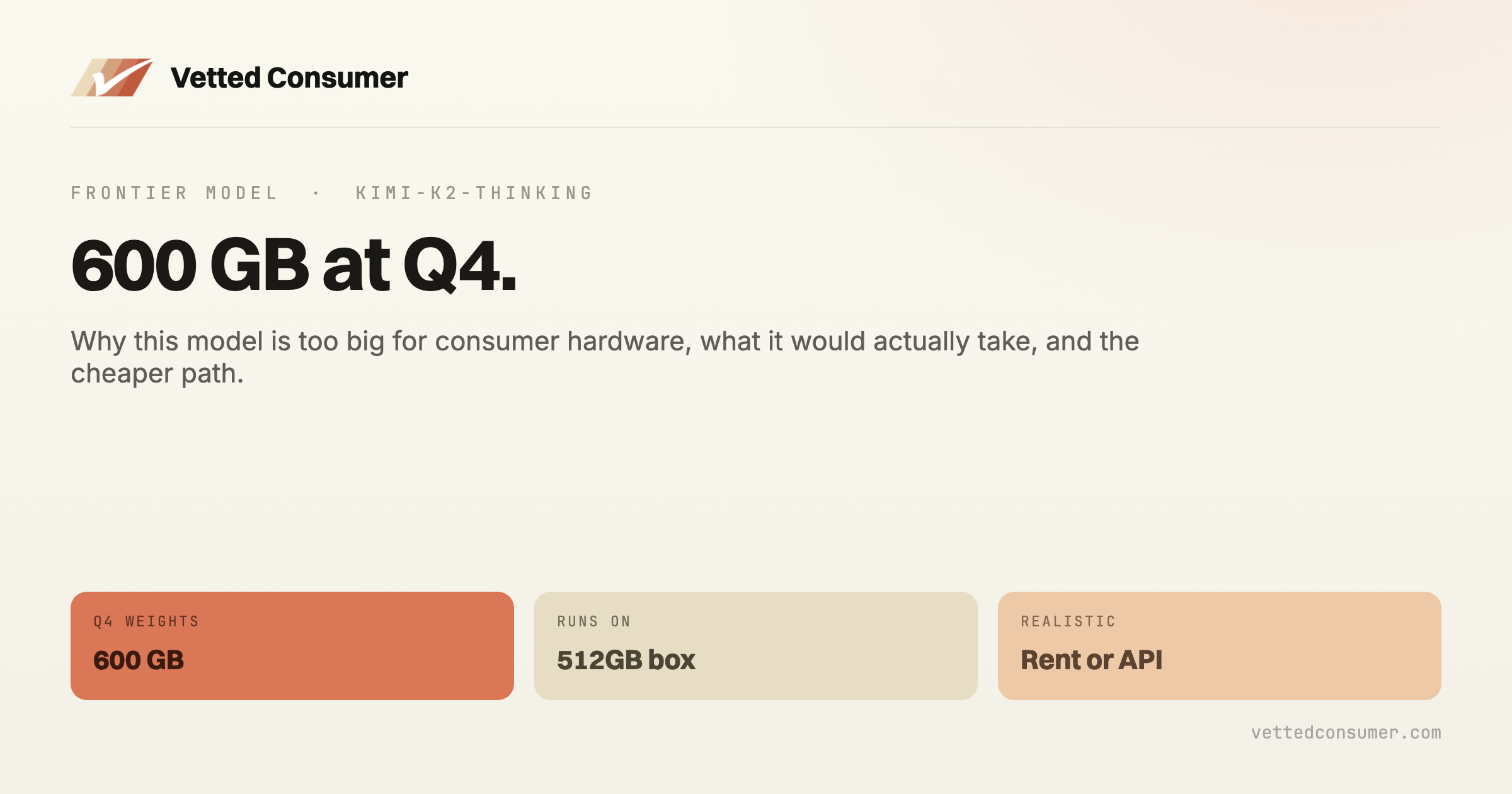
Kimi-K2-Thinking is a 1000-billion-parameter MoE model (modified-MIT) with a 256k context. Because it is a Mixture-of-Experts model, only about 32 B of its parameters are active per token, so it generates faster than its full size suggests, but you still have to fit the whole thing in memory. Reasoning-focused 1T/32B MoE with native INT4 quantization, excels at deep multi-step tool orchestration and agentic workflows. It is a frontier-scale model, which makes the local question blunt: for almost everyone, you do not run this on your own hardware. Here is exactly why, and the cheaper path.
The short answer
Only the largest machines we track can hold Kimi-K2-Thinking, and only at a heavy quant. Here are the ones that fit: For a model this size, renting a cloud GPU or using a hosted API is almost always the saner option.
| Machine | Memory | Quant | Weights | ~tok/s |
|---|---|---|---|---|
| Mac Studio, 512GB unified (Ultra) | 512 GB (unified) | Q3_K_M | ~487.5 GB | ~40 tok/s |
The memory math
Weights scale with parameters. At Q4_K_M (about 4.8 bits) Kimi-K2-Thinking is roughly 600 GB of weights; squeezed to a low-quality Q2 it is still about 419 GB, before you add the KV cache and overhead. That puts it in an 8-GPU H100/H200 server (640 GB+) or a cloud instance territory, not consumer hardware. The VRAM guide and the quantization guide walk through the trade-offs, and why a Mixture-of-Experts model is cheaper to serve than its size implies.
Or just rent it (the realistic option)
At this scale, renting a GPU by the hour or calling a hosted API almost always beats buying. Our cost calculator does the buy-versus-rent-versus-API math for your actual usage, so you can see the break-even instead of guessing. One upside of its Mixture-of-Experts design: hosts can serve it more cheaply than a dense model its size, so API pricing is often reasonable.
Check the details
- Can I Run It? confirms the fit against any specific machine, including your own.
- All hardware, one sortable chart shows the biggest boxes we track.
- Cost calculator for the rent-versus-buy decision.
Sources and method
Last verified July 2026. Specs and model sizes are re-checked as new hardware and quants ship; owner-measured figures are dated at their source.
- Memory requirements computed from the model's parameter count and standard quant bit-rates with the same engine as our calculator.
- A fit-and-feasibility reference, not first-hand testing by Vetted Consumer. Verify the model's exact parameter and active-parameter counts on its model card before relying on the numbers.