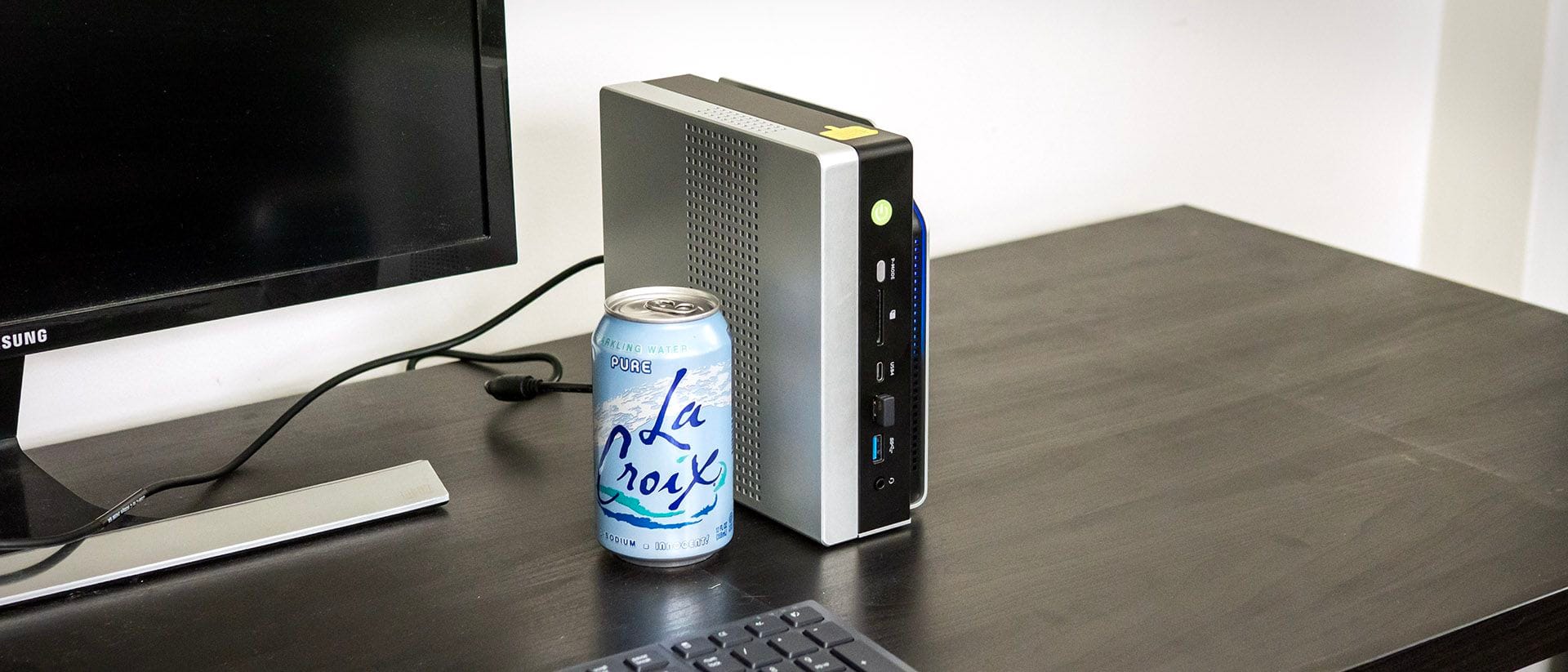
For everyone who wants to run big AI models at home but can't stomach a $2,000+ GPU rig, the GMKtec EVO-X2 is a genuinely new option. Built on AMD's "Strix Halo" Ryzen AI Max+ 395 with up to 128 GB of unified memory, it's one of the most affordable mini PCs that can run 70-billion-parameter models locally, no discrete GPU required.
🧮 Not sure your machine can run the models discussed here? Check it in our calculator →
What it is
A small-form-factor PC pairing a 16-core Zen 5 CPU (to 5.1 GHz), a 40-CU RDNA 3.5 integrated GPU, and a 50-TOPS XDNA 2 NPU, with up to 128 GB of LPDDR5X on a 256-bit bus (~256 GB/s). Plus Wi-Fi 7 and USB4. Pricing now runs from roughly $1,300–$1,500 (64 GB) up to about $2,199 (128 GB/2TB), well above the launch figures as memory prices climbed.
Who should buy it
This is for the local-AI crowd: developers and hobbyists who want to load 35B–70B models (reviewers even ran Qwen3 235B on the 128 GB unit) without renting cloud GPUs or building a multi-card tower. If that's you, the 128 GB EVO-X2 is the value play.
The real tradeoff
It's the same story as the Mac Studio and DGX Spark: huge unified memory lets big models fit, but the ~256 GB/s bandwidth means generation speed is modest (think low-double-digit tokens/sec on the largest models). It's an inference and development box, not a raw-throughput monster.
How it compares
Versus a DGX Spark you trade CUDA and NVIDIA's stack for a lower price; versus a Mac Studio you give up bandwidth and macOS polish but pay far less for the same memory capacity; versus an RTX 5090 you lose speed but smash through its 16–32 GB VRAM ceiling. On dollars-per-gigabyte-of-model, the EVO-X2 wins.
What owners on Reddit are saying
The EVO-X2 lives mostly in r/LocalLLaMA and r/MiniPCs, where the audience cares about exactly one thing: can it run big models? The most useful owner account is u/Eugr’s "Strix Halo vs DGX Spark, Initial Impressions", written by an AI developer who bought both a GMKtec EVO-X2 (128GB) and NVIDIA’s $4,000 DGX Spark to compare head-to-head:
"Inference-wise, the token generation is nearly identical to Strix Halo… but prompt processing is 2–5x higher [on the Spark]. Strix Halo performance in prompt processing degrades much faster with context.", u/Eugr
The straight read from that thread: for pure token generation the EVO-X2 keeps pace with hardware costing far more, its weakness is prompt processing on long contexts. Owners are also watching the price. As u/b0tbuilder noted, the 128GB EVO-X2 saw a ~$200 price jump within weeks of purchase as memory prices climbed, so the "sub-$1,500" framing is increasingly a moving target. The community consensus matches ours: it’s the cheapest sane way to fit a 70B-class model entirely in fast unified memory, as long as you go in knowing prompt processing, not raw token speed, is the compromise.
The bottom line
If your goal is running large local models affordably, the 128 GB GMKtec EVO-X2 is still a strong value in 2026, just go in knowing it prioritizes capacity over raw speed. Need CUDA or fast generation? Look at the DGX Spark or a Mac Studio instead.