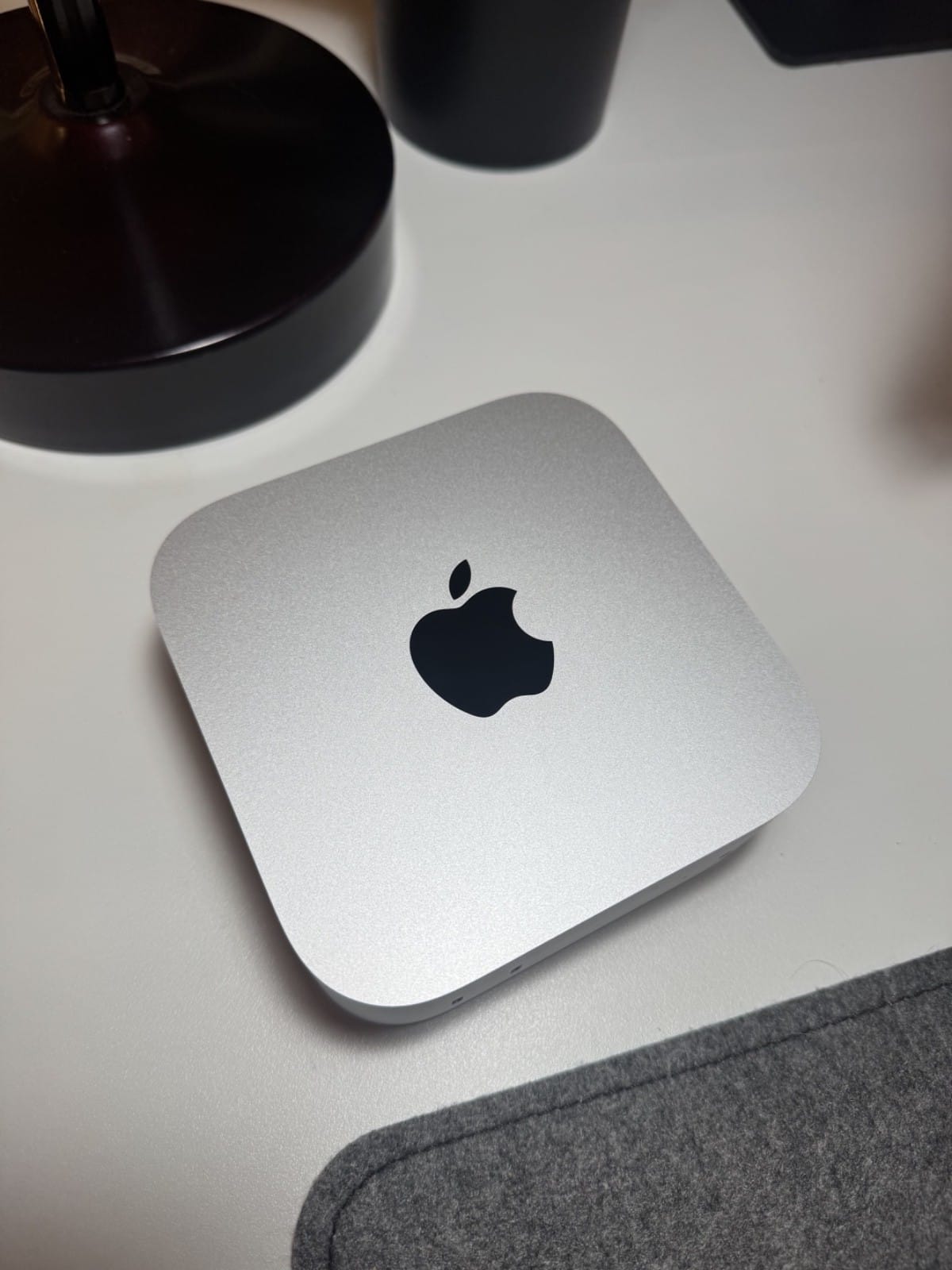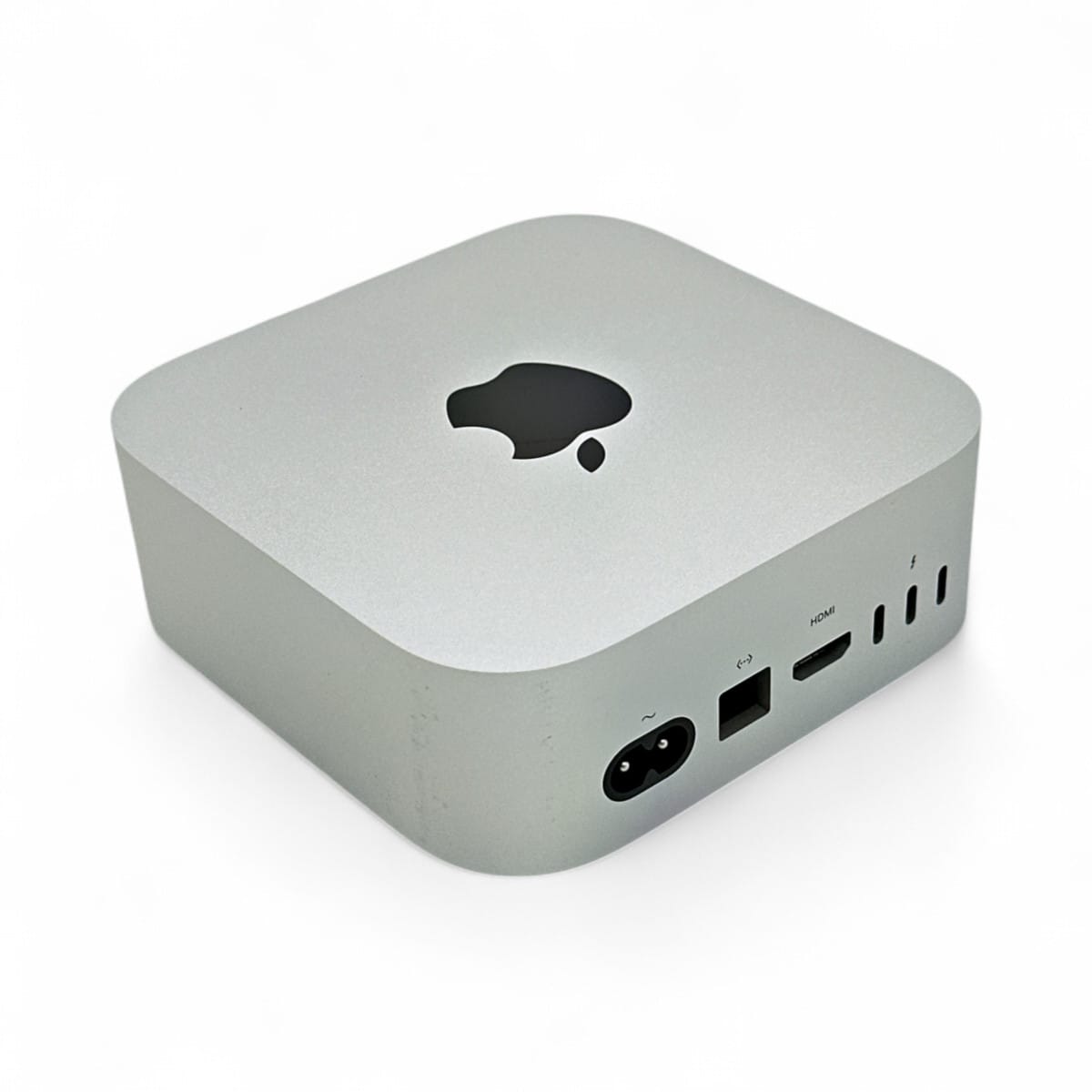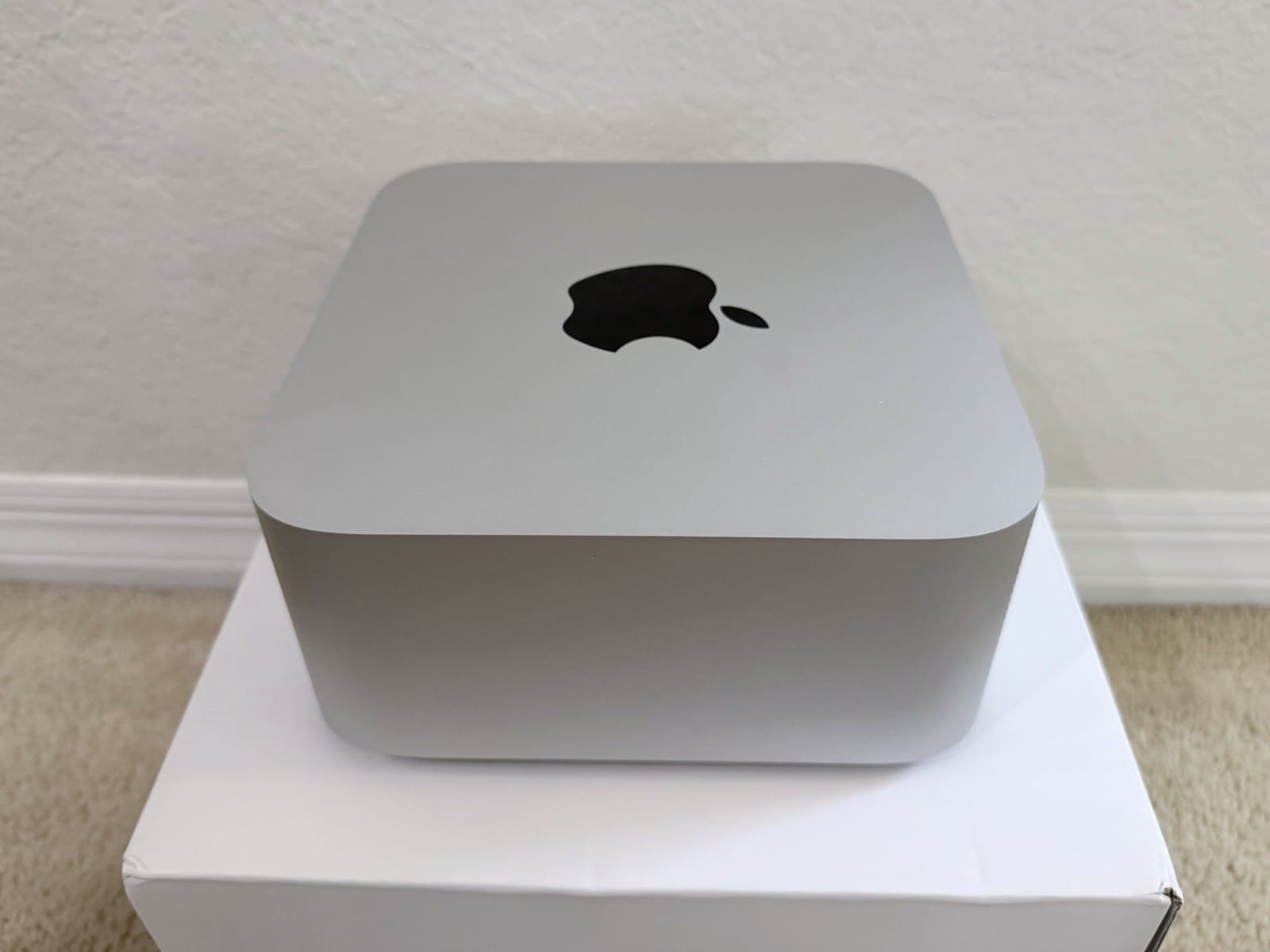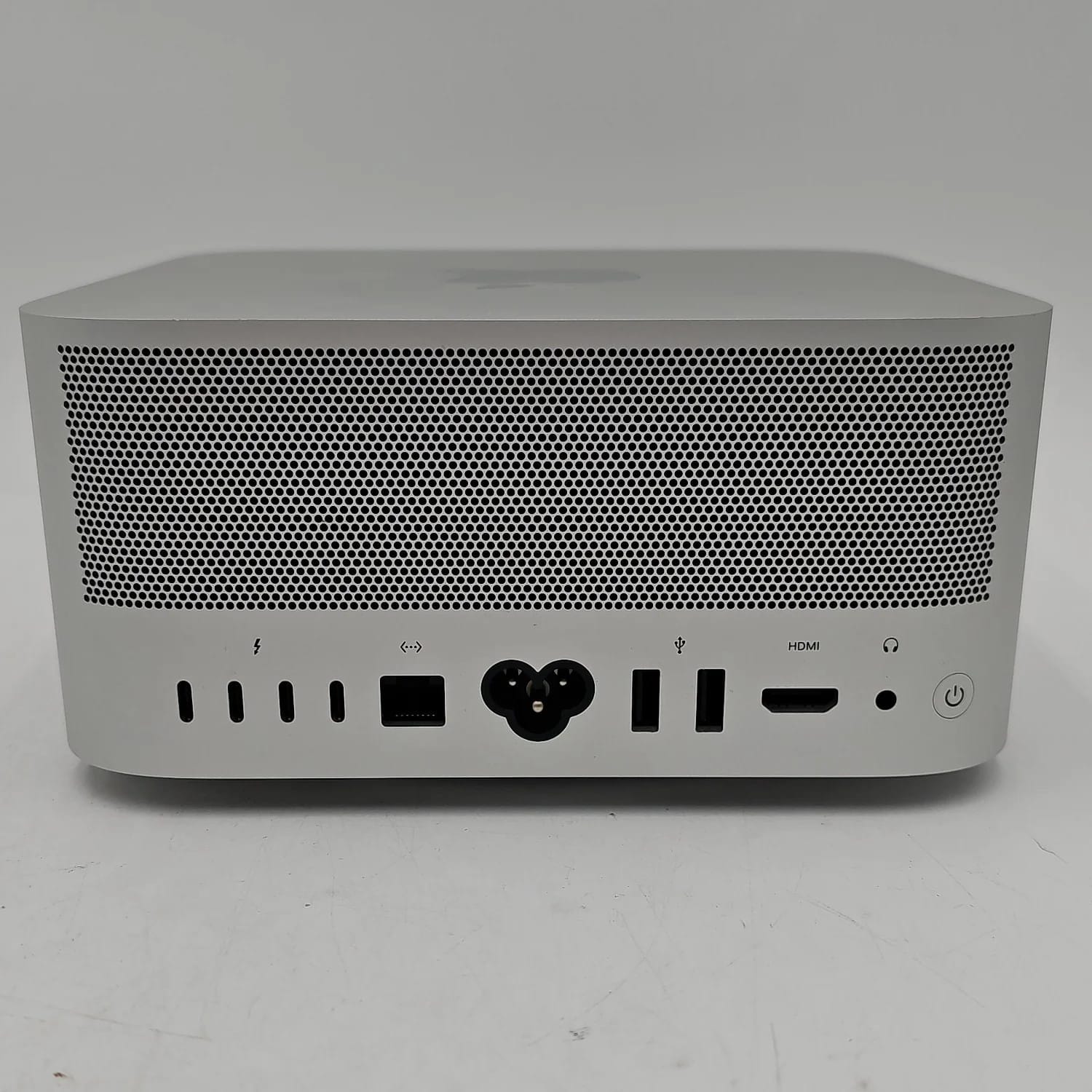
Our MoE-era piece ended in a buying rule: capacity first, bandwidth second. In practice, that points most people at one memory tier, 128GB of unified memory, and two very different ways to buy it: an AMD Strix Halo mini-PC or a Mac. Which one wins is the question our inbox keeps asking, and late July delivered an unusually good set of third-party measurements to answer it with: a three-way instrumented test from Tom's Hardware, a public per-backend benchmark grid from the Strix community, and owner reports with real power bills. We have not tested these machines first-hand; this piece is built from other people's published numbers, credited throughout.
The contenders, and the price chart that changed the fight
On paper this is a clean trade. A Strix Halo box (Ryzen AI Max+ 395, Radeon 8060S, 128GB of LPDDR5X) moves about 256 GB/s. A Mac Studio M4 Max with the 16-core chip moves 546 GB/s, twice the bandwidth. NVIDIA's GB10 boxes (DGX Spark and clones) sit between them at 273 GB/s. Since decode speed follows bandwidth, the Mac should be the fast option, and it is. The 2026 problem is the other panel:
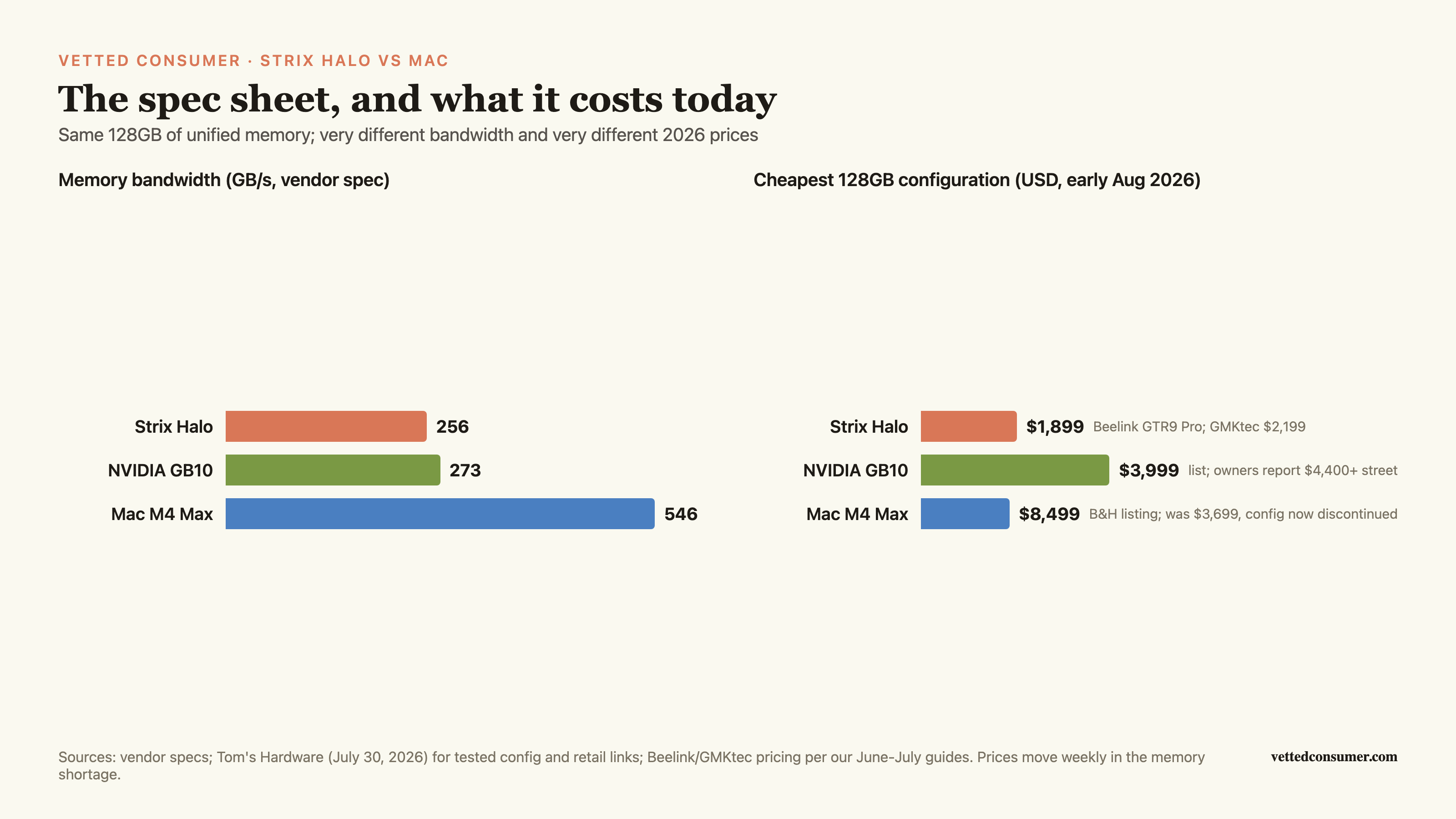
When Tom's Hardware tested the 128GB M4 Max Studio, it cost about $3,699, a fair fight with a $1,900-to-$2,200 Strix box. Then the memory shortage hit Apple's configurator: per the same article, the M4 Max Studio "now tops out at 64GB of RAM" with lead times over two months, and the 128GB unit they tested shows up at $8,499 from B&H. Apple's remaining capacity path is the M3 Ultra Studio (96GB base, up to 512GB), a different class and budget, the one we covered in the M3 Ultra review. Meanwhile the cheapest 128GB Strix boxes (GMKtec EVO-X2, Beelink GTR9 Pro, Framework Desktop) sit under $2,200. The spec battle became a price rout before the benchmarks even ran.
What Tom's Hardware measured
The test (Jeffrey Kampman, July 30, llama.cpp with Unsloth Q4 quants) is the cleanest apples-to-apples-to-oranges run of these three platforms published so far, and its headline finding cuts both ways:
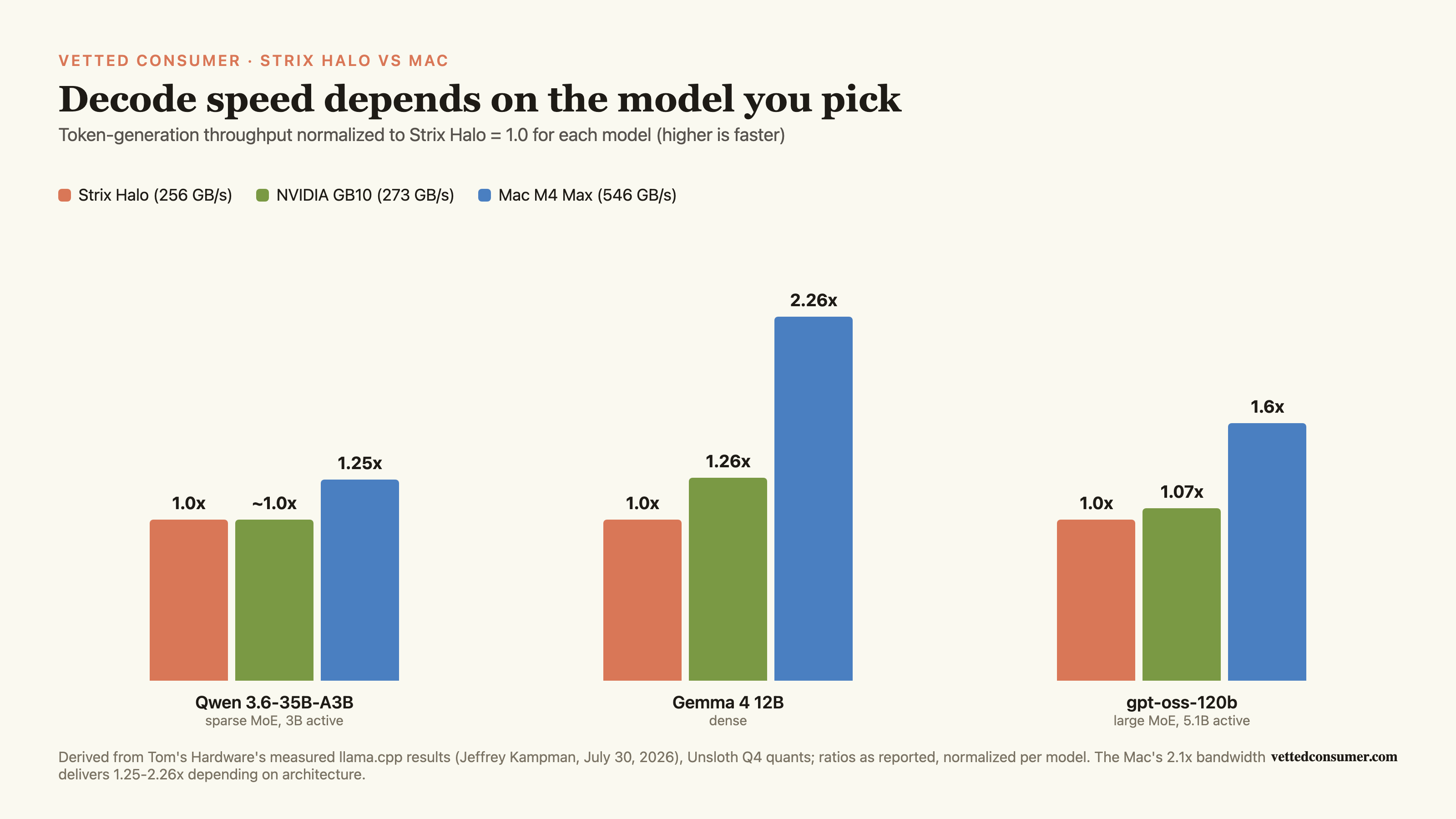
On the dense Gemma 4 12B, bandwidth translates almost perfectly: the Mac decoded 2.26x faster than Strix Halo. On the sparse MoE models that now dominate releases, the gap shrinks hard: 1.6x on gpt-oss-120b, and just 1.25x on Qwen 3.6-35B-A3B. In their words: "a memory bandwidth specification alone isn't a good proxy for delivered performance."
Three more results from the same piece fill out the picture. Prompt processing is not a Mac strength: it landed between Strix Halo and GB10 on the MoE models and "in line with (or even slightly worse than) Strix Halo" on Gemma, which matters for long-context and agent work. Image generation flipped the ranking entirely: the M4 Max was slower than Strix Halo's Radeon 8060S, after an FP8 compatibility failure forced a workflow change. And CPU performance went decisively to Apple: 27% faster single-core than the 16-core Zen 5 in Geekbench 7 and a llama.cpp compile finished about a third faster.
The Strix numbers in absolute terms
Tom's gives clean ratios; the Strix community gives clean absolutes. The most-cited public dataset is kyuz0's backend grid, run on a Framework Desktop 128GB:
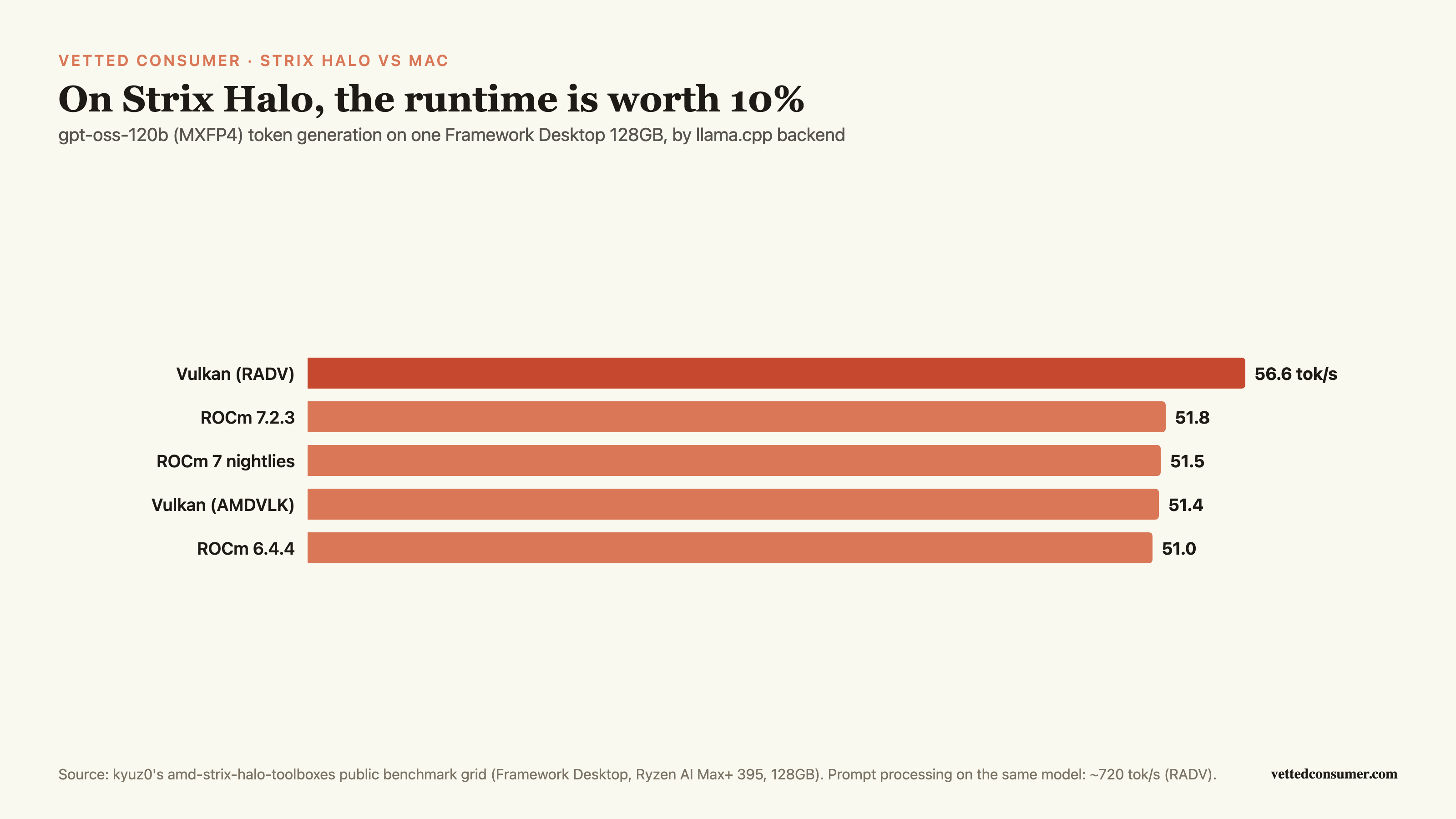
Read against the ratios above, that implies the $8,499 Mac would do roughly 90 tokens per second where the $1,899 box does 56. Both are comfortably past reading speed; one costs four and a half times the other. The grid also shows the familiar lesson from our runtime guide: backend choice alone is worth about 10% on this hardware, free.
The software story, long Strix Halo's weak flank, moved fast this summer: Unsloth shipped official AMD support (inference and fine-tuning, with prebuilt ROCm llama.cpp), and one open-source project reported DeepSeek V4 Flash at up to 32 tok/s on a single 128GB Strix box using a custom 2.88-bit mix plus speculative decoding. That last number is the project's own submission, not an independent test, but the run is public and the code is Apache 2.0, and it shows where this tier is headed: frontier-adjacent models on one quiet box.
What owners keep saying
The Strix camp's argument is value per watt, put best in a 169-upvote r/LocalLLaMA post titled "At most my Strix Halo uses $0.48 a day": "This 48 cent figure is worst case scenario... I can handle only 50tps on Q8_XL Qwen 3.6 35B when it's silent, sipping power, and is the size of a small router." And on today's market: "Even with the current inflated prices, I think these things have insane value."
The same thread carries the price reality both ways. One owner: "I paid $1,900 for a strix halo... strix and sparks are all crazy expensive right now... I can't find a spark for less than 4400, and I can still find strix for under $3,100." The Mac camp's voice, from the threads in our M3 Ultra coverage, is quieter but consistent: people pay for the bandwidth, the silence, and macOS, and the ones without $4,000 budgets are explicitly waiting: "I'm personally waiting for a 128GB M5 Max or Ultra Studio."
The decision cheat-sheet
| You are... | Buy | Because |
|---|---|---|
| Most people entering the 128GB tier in 2026 | Strix Halo box ($1,899–$2,199) | The Mac that competed here effectively left the market; 56 tok/s on gpt-oss-120b is plenty |
| Running dense models, or allergic to Linux tinkering | Mac (M3 Ultra 96GB+ today, or wait for M5 Studio) | Dense decode scales with bandwidth (2.26x measured); macOS + MLX is the low-friction path |
| Agent/coding workloads with long prompts | Neither is great; GB10 wins prefill | Prompt processing is compute-bound and the Mac's weak spot too |
| Image/video generation on the side | Not the Mac | Measured slower than Strix Halo's 8060S, plus FP8 compatibility friction |
| 24/7 home server on a power budget | Strix Halo | ~120W box, owner-measured pennies per day, full Linux services stack |
| Chasing the 400B-class models | Wait or step up | 192GB "Gorgon Halo" boxes are coming per Tom's reporting; the 512GB M3 Ultra owns that tier today |
The verdict
Twelve months ago this was a genuine dilemma at similar money: Apple's bandwidth against AMD's price. The memory shortage settled it for now. With the 128GB M4 Max Studio discontinued at the configurator and its leftovers listed near $8,499, Strix Halo wins the 128GB tier mostly by staying on sale at $1,899-$2,199, and the measured numbers say what you give up is far less than the spec sheet implies: 1.25-1.6x on the MoE models everyone runs, in exchange for a 4x price gap, better image generation, and a fraction of the power draw. The Mac case survives at the edges (dense-model speed, macOS, best-in-class CPU) and it may return in force if an M5 Studio restores high-memory configs at 2025 prices. Until then, the boring conclusion from everyone else's benchmarks is that the cheap box is the right box. Check what the tier runs against your own shortlist in the calculator.
Sources and how we researched this
- Three-way measured comparison, spec table, current retail links, and quotes: Tom's Hardware, "Exploring Apple Silicon's local AI performance" (Jeffrey Kampman, July 30, 2026). Our chart 2 normalizes the ratios that article reports.
- Strix Halo absolute throughput by backend: kyuz0's amd-strix-halo-toolboxes grid (Framework Desktop, 128GB), reproduced in chart 3.
- Software ecosystem: Unsloth's AMD support announcement; the Lucebox V4-Flash-on-Strix report (project self-report, open source, labeled as such).
- Owner sentiment and street prices: the linked r/LocalLLaMA threads, quoted verbatim and attributed.
- Strix box pricing: our GMKtec EVO-X2 guide price history and the Beelink GTR9 Pro listing it tracks.
- All charts in this piece are ours, drawn from the cited data; we have not benchmarked these machines first-hand. Prices are early-August 2026 snapshots and move weekly.
Related: Strix Halo vs DGX Spark, per owners of both · Mac Studio M3 Ultra for local AI · Every frontier open model is a MoE now · Bandwidth, Not TFLOPS