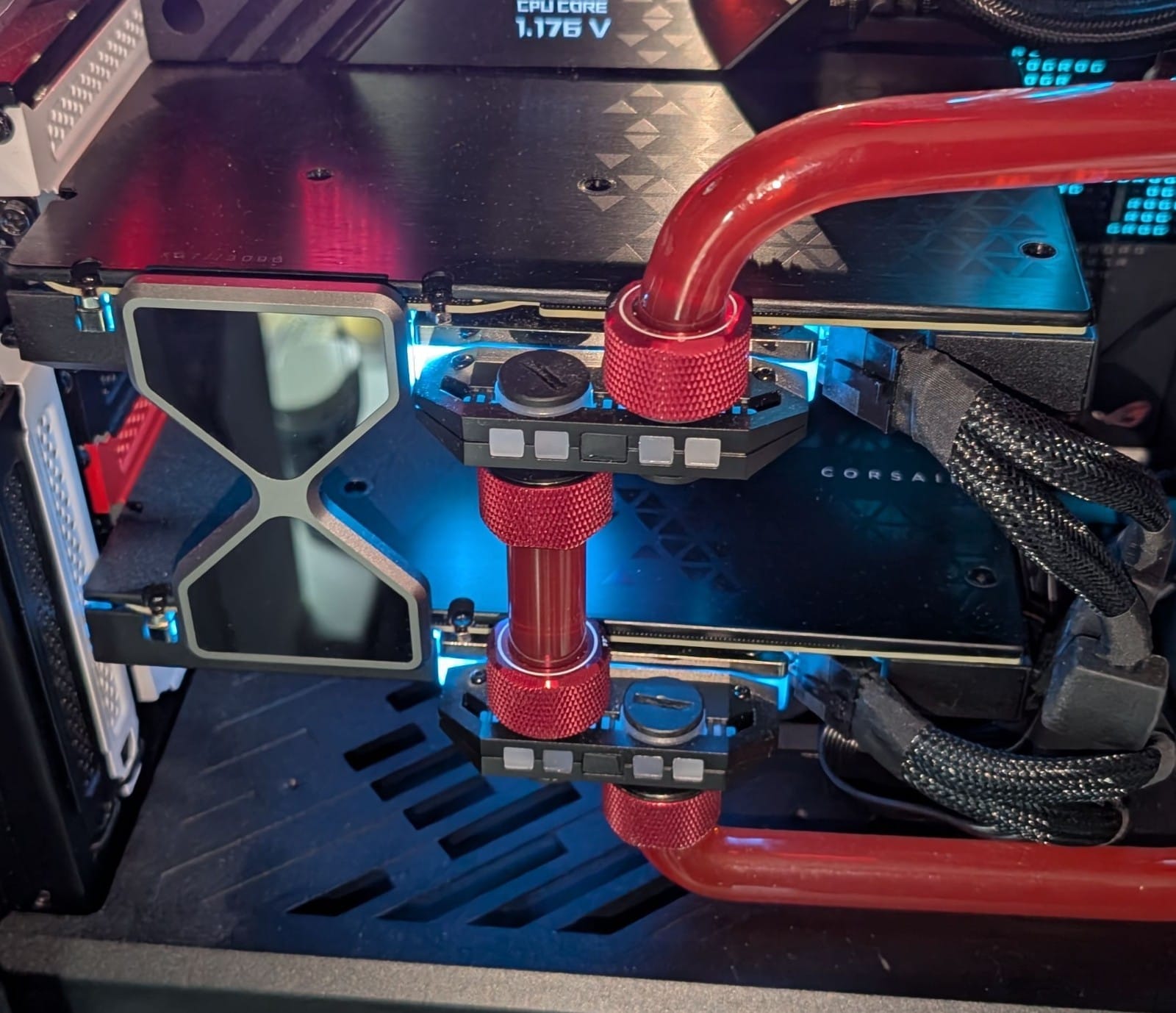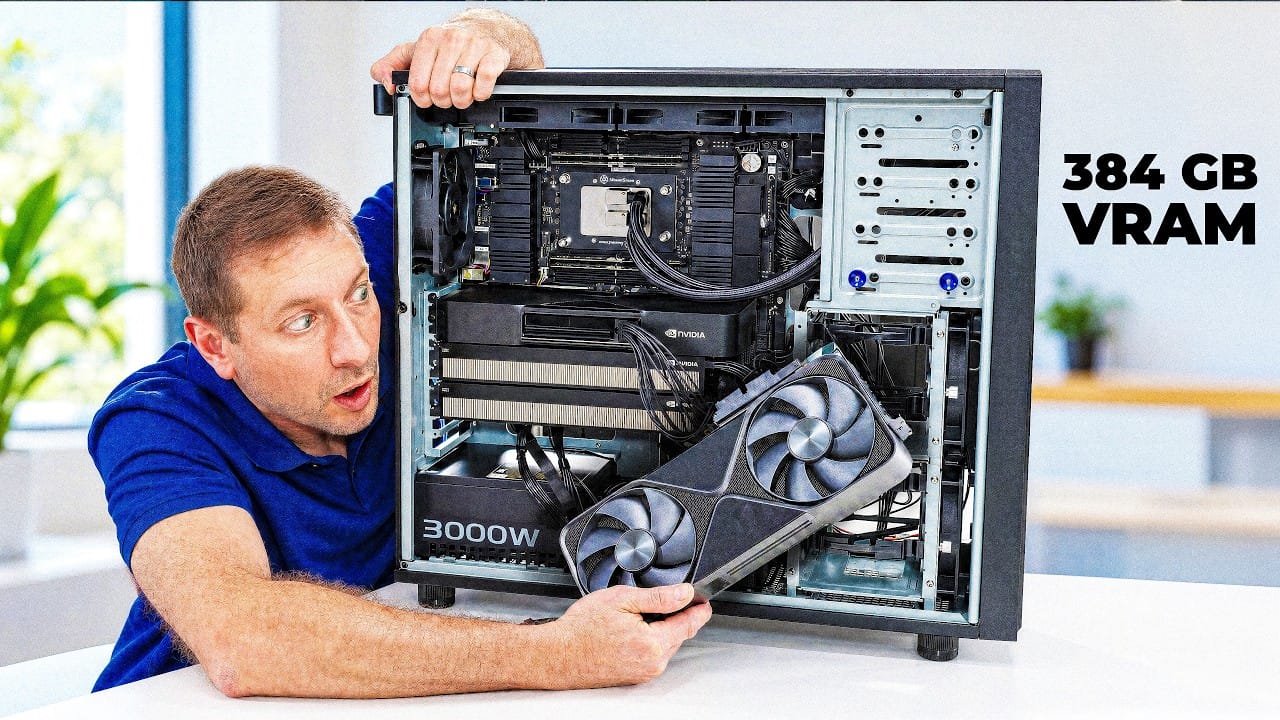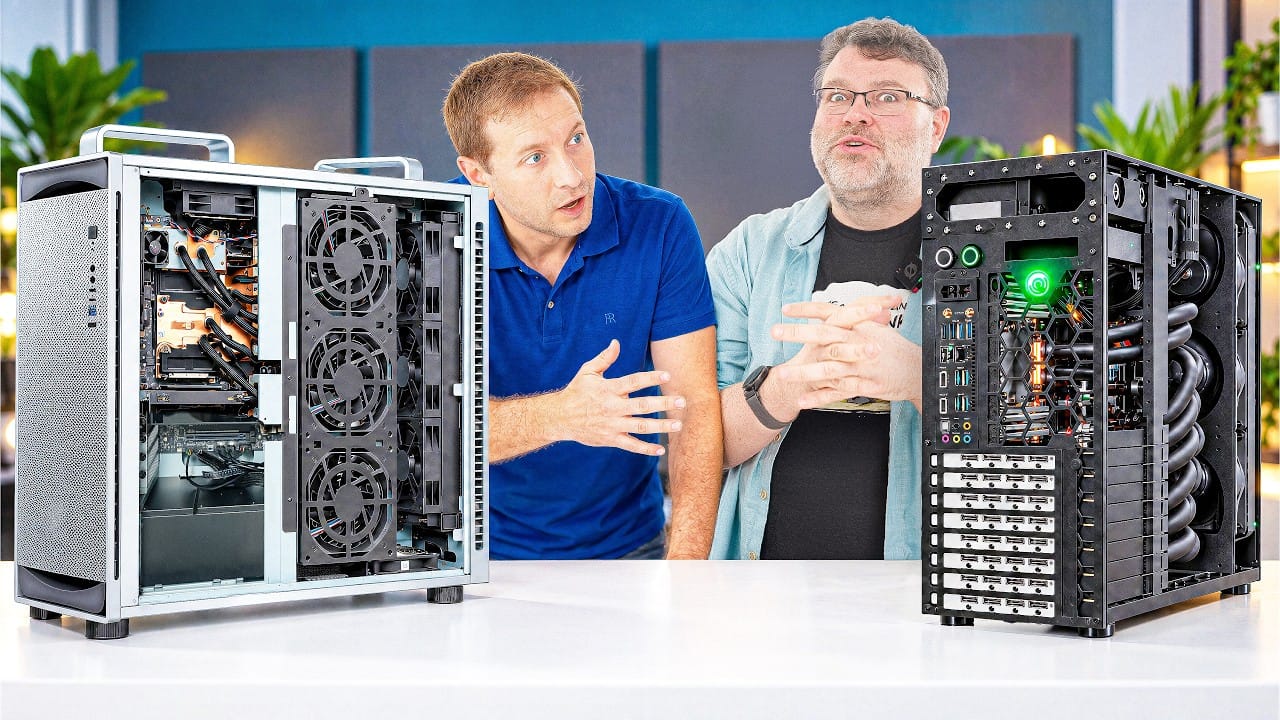
Two weeks ago we covered ServeTheHome's DGX Station review and could only estimate how it compares with a box full of RTX Pro 6000 cards. Alex Ziskind has now put both in one room. In I Gave Two AI Supercomputers a Real Job (7 October 2026), he and Wendell of Level1Techs run NVIDIA's GB300 DGX Station against a Comino Grando with eight RTX Pro 6000s, on real coding-agent work rather than synthetic benchmarks. The answer is the one the architecture predicts, with a twist on the agent job that makes it worth watching.
The two machines
| NVIDIA DGX Station (GB300) | Comino Grando, 8× RTX Pro 6000 | |
|---|---|---|
| Fast memory | 252GB HBM3e on one GPU, 7.1TB/s | 768GB GDDR7 across eight GPUs, 1.79TB/s each |
| Slower memory | 496GB LPDDR5X at 396GB/s, coherent with the GPU | 512GB DDR5 system RAM in StorageReview's unit |
| GPU-to-GPU link | Not needed: one GPU | PCIe Gen 5, no NVLink |
| Power | 1,600W, 20A circuit | Four 2,000W supplies, 6.5kW cooling capacity |
| Noise | 36–46dBA (ServeTheHome) | "70+ dB at full tilt" (StorageReview) |
| Price | About $95,000–$129,000 from resellers | Quote only; Comino publishes no list price |
Station figures are from NVIDIA's spec page and ServeTheHome; Grando figures from StorageReview's review. In the video Ziskind runs the Grando from four wall plugs and, for comedy and proof, the Station from a portable battery station: it idled at 319W and took the battery down to 86% in 45–50 minutes. With both machines busy, he counts about 6,000 watts of heat in the room and keeps the door shut.
The memory question, explained by Wendell
Wendell's explanation is the clearest one-paragraph case for each machine we have heard. The Station's 252GB of HBM runs at about 7TB/s, an "absurd amount of memory bandwidth", so any model under that size runs on one GPU at speeds a GDDR7 card cannot match; he singles out gpt-oss-120B, which sits entirely in HBM, as running at "an absurd speed" for a single user. Beyond 252GB the Station spills into its LPDDR5X pool, which still works, "just a little bit slower". The Grando has no HBM, but its eight cards hold 768GB of fast memory between them. The cost is the link: the cards talk over PCIe Gen 5 x16, about 64GB/s each way, which Wendell calls "just pedestrian".
That link matters because splitting one model across eight cards means the cards synchronise inside every layer. The scheme behind that split, from the Megatron-LM paper (Shoeybi et al., 2019), needs two all-reduce operations per transformer layer, and on PCIe those become the bottleneck. Our multi-GPU explainer covers the mechanism; it is why the Grando's 768GB is capacity first and speed second.
The DeepSeek test shows both sides. DeepSeek V4.1 Flash at FP8 is a 614GB download. On the Grando all of it fits in GPU memory; on the Station part of it has to live in the slower pool. Ziskind's chart puts the Grando at 307 tokens per second on V4.1 Flash, and he and Wendell agree it is ahead "just by a little bit". Wendell's point is that newer mixture-of-experts designs tolerate having some weights in slower memory, so the Station loses less than the 252GB figure suggests. For prefill, he says, "you're never going to beat HBM."
The real job: an agent team on each box
Most of the video is spent in Turnstone, an open-source (Apache 2.0), self-hosted orchestration tool for tool-using agents that Wendell uses for his own development. It runs a manager, workers with personas and an auditor, and lets you point each at a different model server. Ziskind gives it two real tasks from his own GitHub: port a Windows developer-setup script to Windows on ARM, and fix a known bug in his code-needle benchmark. The bug was found and fixed using about 15,000 tokens. The ARM job came back with a list of incompatible packages and fixes, including the suggestion to move from Chocolatey to WinGet.
Then the comparison: Ziskind ran the same ARM job with the same model on each machine. By his count from Turnstone's database:
| Machine | Time to finish | Input tokens used |
|---|---|---|
| DGX Station | 21 minutes | About 26 million |
| Comino Grando | 37 minutes | About 23 million |
He is careful to say it is not a strict one-to-one comparison, since agent runs are not deterministic. Still, the Station finished an agentic job in a little over half the time while processing slightly more tokens, which is what HBM's prefill advantage predicts: agent loops re-read large contexts constantly, and prefill is where HBM wins most. That matches AZisk's earlier finding in his quad RTX Pro 6000 build that agent work is dominated by everything around the model call, not single-stream generation speed.
On throughput for teams, the video shows multi-user figures on screen, which Ziskind and Wendell read out as 3,800 tokens per second and "just over 2,000" on Nemotron 3 Super 120B-A12B. StorageReview's lab numbers for the Grando give the shape of how it scales: running MiniMax M2.5 under Claude Code sessions, one session got 67.3 tokens per second, eight concurrent sessions 38.7 each (206.7 combined), and at sixteen sessions the combined rate fell to 105.8. Serving setups have a sweet spot, and more users past it is slower for everyone.
The cost argument
Ziskind closes with the number that decides whether either machine pays off. At current API prices, he estimates the Windows ARM job alone would have cost about $5 on a small model to $36 on a top model with prompt caching, and $24 to $240 without it. "One afternoon is not going to pay for a DGX Station," he says, but a team keeping it busy around the clock can make the sums work. Wendell describes the setup he runs himself: a frontier cloud model as the manager, spending tokens sparingly, directing eight or ten local workers on models like Nemotron 3 Super that are "smart enough" for unit tests and integration work. His own workers run on two GB10 machines (a DGX Spark and Dell's GB10 Pro Max), which he describes as fine for a team of up to four. That is the useful takeaway for anyone without $100,000: the orchestration pattern works on DGX Spark-class hardware too, and Turnstone runs on anything.
What viewers are saying
Viewers mostly celebrated the pairing. @Dygear's 125-like summary: "This video is the Mixture of Experts that we didn't know we needed." @mysomervda praised fitting "2 hours of content into 18 minutes", and @EatThisBurg, running agents on an 8GB RTX 3070, called it "glorious eye candy". The reality checks came too: @joshuadurey reacted to the 6,000 watts, and @mimimoo4493 noted dryly that a "$120k desktop pc is definitely relateable for everyday users". Wendell himself, posting as @Level1Techs, said he is taking the Grando home for more testing, so expect deeper numbers on his channel.
Verdict
The video settles the question we left open. If your models fit in 252GB and your work is agents or anything prefill-heavy, the DGX Station is the faster machine, quieter, and on one wall socket; it finished the same real coding job in about 58% of the Grando's time. If you need models above 252GB entirely in fast memory, such as FP8 DeepSeek V4.1 Flash, the Grando's 768GB holds them and was slightly faster there, at the cost of 6kW-class power, PCIe synchronisation and server-room noise. Neither is for one person. For a team, the bigger lesson is Wendell's pattern of a cloud manager plus cheap local workers, which scales down to hardware most readers can afford. Run your team's token volume through the cost calculator before buying anything in this class.
Sources and how we researched this
Primary source: Alex Ziskind with Wendell of Level1Techs, "I Gave Two AI Supercomputers a Real Job" (7 October 2026), summarised from the transcript with attribution; the sponsor segment was left out. Hardware: NVIDIA DGX Station specifications, StorageReview's Comino Grando review (Dylan Dougherty, April 2026) and our summary of ServeTheHome's DGX Station review. Software: Turnstone on GitHub. Research: Shoeybi et al., Megatron-LM: Training Multi-Billion Parameter Language Models Using Model Parallelism (2019). Viewer comments from the video. Numbers shown only on screen are quoted as read aloud. We have not tested either machine; the site is non-commercial.
Related: GLM-5.3-Flash: what runs it · DeepSeek V4 Flash tested · Serving a local LLM as an API