ServeTheHome has had the first NVIDIA DGX Station-class machine on its bench: Gigabyte's W775-V10-L01, a GB300 system that is, in Patrick Kennedy's words, "all of the critical components of a GB300 server, brought down to a desktop workstation." The headline number in the video (6 October 2026) is over 26,000 tokens per second, or about 2.25 billion tokens a day. That figure is real, and it is also the least useful number for most readers of this site, because it comes from 512 simultaneous users. This piece pulls out what the machine does for one user, what it does for a team, and how it compares with the four-GPU workstations people usually build instead.
Disclosure from the source: ServeTheHome writes that "Gigabyte loaned us this unit so we could make this content" and labels it sponsored. Vetted Consumer has no relationship with Gigabyte or NVIDIA.
What is in the box
A DGX Station is not a PC with a big graphics card. NVIDIA supplies the motherboard with the processors already fitted, and the vendors build the case and cooling around it. The parts, per NVIDIA's spec page:
| Part | Specification |
|---|---|
| GPU | One Blackwell Ultra (B300), 252GB HBM3e at 7.1TB/s |
| CPU | 72-core Grace (Arm Neoverse V2), 496GB LPDDR5X at 396GB/s |
| CPU–GPU link | NVLink-C2C, 900GB/s |
| Total coherent memory | 748GB |
| AI compute | Up to 20 PFLOPS FP4 |
| Networking | ConnectX-8 SuperNIC, 2× 400Gbps |
| Power | 1,600W total; NVIDIA states a 20A circuit is required |
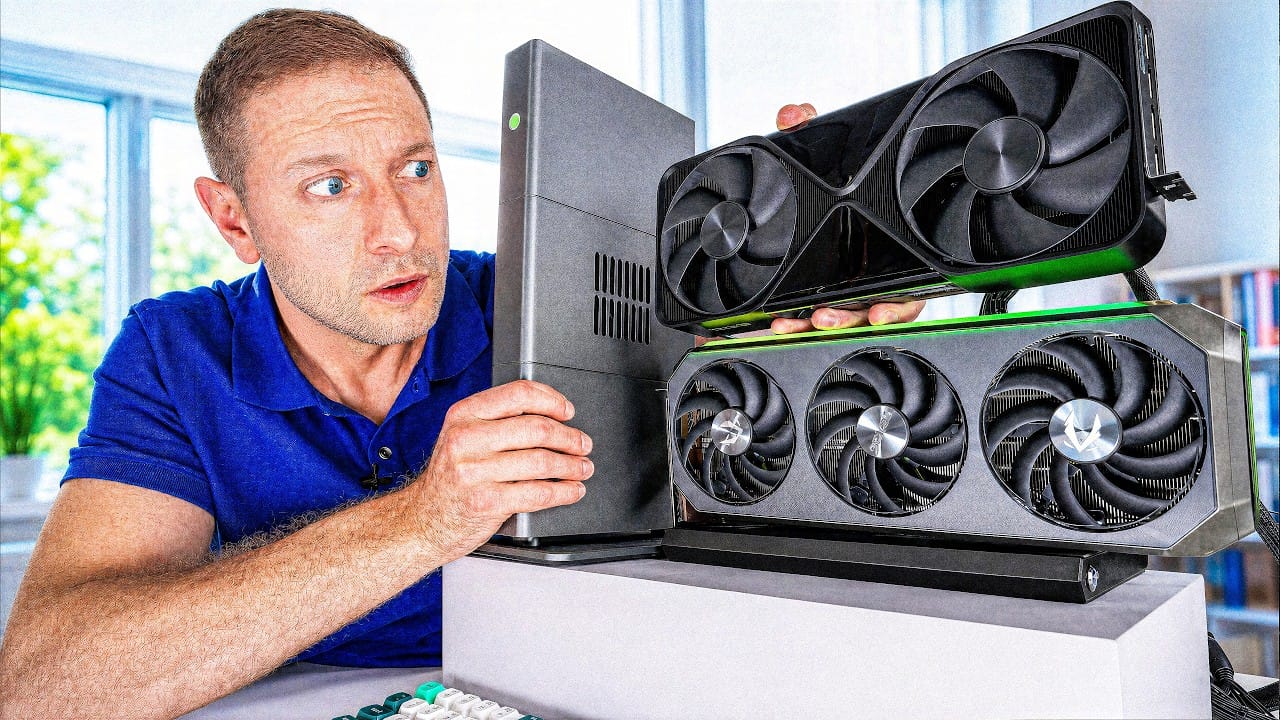
Gigabyte's version is a 29kg liquid-cooled tower (Gigabyte specifies a two-person lift) with leak-detection strips inside and its ports on the top panel, because it is meant to sit on the floor. Kennedy calls it "a hundred-thousand-dollar workstation". Reseller listings we found range from a reported $95,000 listing to AVADirect's $128,709 starting configuration.
What ServeTheHome measured
The concurrency results are the reason the machine exists:
- Qwen3.6-35B-A3B at NVFP4: well over 26,000 tokens per second at 512 concurrent users with short prompts and 1,024-token outputs. That is the 2.25 billion tokens a day.
- Nemotron 3 Super 120B-A12B: around 7,000 tokens per second at 512 users, and 86.5 million tokens a day "even at very reasonable concurrency levels".
- GLM-5.3 Flash (321B MoE) and DeepSeek V4 Flash (284B MoE): both ran with what Kennedy calls reasonable time to first token. He notes that OpenRouter providers were serving GLM-5.3 Flash at 20–40 tokens per second, so the box "is outperforming the cloud providers" for that model.
The single-user figures are in a coding test. ServeTheHome asked both large models to build a browser kart-racing game with original artwork. DeepSeek V4 Flash generated at about 120 tokens per second and GLM-5.3 Flash at about 100, but GLM finished the main coding work in roughly 2.1 hours against DeepSeek's 4.7. Raw token speed did not predict which model got the job done first. Kennedy's summary covers both ends: big models at "40-100T/s for a single user", or small models at tens of thousands of tokens per second across many agents.
The memory split decides what runs fast
The 748GB figure is two different pools, and the review's most useful experiment shows why that matters. Only the 252GB of HBM on the GPU runs at 7.1TB/s. The 496GB of LPDDR5X on the Grace CPU runs at 396GB/s, about an eighteenth of that. ServeTheHome ran Qwen3.8 27B, GLM-5.3 Flash, DeepSeek V4 Flash and Qwen3.8 Flash Next with the weights in each pool and on each processor. Prefill tolerated the weights sitting across the C2C link, since it is compute-bound. For generation, the conclusion was "why you clearly want to use HBM for decode", although feeding the GPU from LPDDR5X over the link still beat running on the CPU directly.
In practice: a model has to fit in 252GB to run at the speeds above. DeepSeek V4 Flash at 4-bit is roughly 160GB and GLM-5.3 Flash roughly 180GB, so both fit with room for cache. Something like Hy4 preview at 435GB would load into the combined 748GB, but its weights would spill into the 396GB/s pool, and generation would fall below a 512GB Mac Studio's 819GB/s. The capacity is real; the speed belongs to the HBM. The bandwidth explainer covers why.
Networking, CPU, power and noise
ServeTheHome found one limit the spec sheets do not mention. The ConnectX-8 NIC connects to the GPU over PCIe Gen6 x16, so GPU-to-GPU traffic between two stations reached 784.3Gbps over both ports. The Grace CPU, though, connects to the same NIC over only PCIe Gen5 x8, and CPU-side traffic topped out at 228.9Gbps, matching a figure buried in NVIDIA's documentation. If you plan to move data through the CPU, budget for 229Gbps, not 800.
The Grace CPU runs at a 300W limit here with clocks above 3.3GHz, and on ServeTheHome's estimated SPEC CPU2026 integer test it scored about 2.71 per core against 2.58 for an AMD EPYC 8635P. That matters because, as Alex Ziskind measured last month, most of a coding agent's time is spent on the CPU, not the GPU.
Power: the GPU idles around 148W with a 1.3kW cap, the Grace module 77–82W, and the whole system never idled below 250W. The 1.6kW ceiling is shared by everything, including any card added to the PCIe slots. Noise was the surprise: 36–38dBA at low load and 44–46dBA flat out, which Kennedy says makes it suitable for office floors in a way an 8-GPU server never was.
Versus a four-GPU RTX Pro 6000 workstation
This is the comparison several viewers asked for, and the numbers we have point one way for each buyer:
| GB300 DGX Station | 4× RTX Pro 6000 Max-Q workstation | |
|---|---|---|
| Fast GPU memory | 252GB HBM3e, one GPU | 384GB GDDR7 across four GPUs |
| Bandwidth per GPU | 7.1TB/s | 1.79TB/s each |
| Extra capacity | 496GB LPDDR5X at 396GB/s | System RAM over PCIe |
| Splitting a model | Not needed under 252GB | Required above 96GB, with synchronisation cost |
| Power | 1,600W, 20A circuit | About 1,000–1,200W under load in one owner's log |
| Cost | About $95,000–$129,000 | $54,092 in one documented build |
The four-card figures come from the Level1Techs build log we cited in the AZisk piece. The four-card box has more fast memory for less money, but every model above 96GB has to be split across cards, and the synchronisation cost of tensor parallelism (explained in our multi-GPU explainer) eats a large share of the theoretical gain. The Station runs anything under 252GB on one GPU with four times the bandwidth per card, which is why its per-user speeds on 300B-class models are what they are. Its batching advantage follows the same logic as any serving system: keeping weights resident and sharing the KV cache across requests, the approach described in the vLLM PagedAttention paper (Kwon et al., 2023), is what turns one fast GPU into 512 users' worth of throughput.
What viewers are saying
The admiration was mostly technical. @kielbasa_surowa wrote that they "really appreciate seeing what a state-of-the-art desktop sized AI unit capable of running off a 20A 120v circuit and at ~40dB can do", and @mattharper230 kept it short: "What a beast!" Two viewers framed the purchase the way this site would. @mathiswellmann6858 is "debating buying this or 4x RTX Pro 6000 cards", running Qwen3.8 27B at about 450 tokens per second at a concurrency of 8 on a single RTX Pro 6000 with 50K-token prompts. @HaydonRyan asked to see a four-card RTX Pro 6000 system "with the same target price". The most-liked comment, from @acrusso1, was "it's only 100k, what a steal."
Verdict
For a team running dozens to hundreds of agents against 120B- to 300B-class open models, ServeTheHome's numbers make the case: cloud-beating per-user speed on GLM-5.3 Flash, tens of thousands of tokens per second on smaller models, quiet enough for an office, and on a single GPU, so there is no splitting to tune. For a single person, it is the wrong purchase at any income. The per-user speed on the big models is 100–120 tokens per second, which a far cheaper box or an API matches for a fraction of the cost. Run your volumes through the cost calculator before deciding a machine like this pays for itself.
Sources and how we researched this
Primary source: ServeTheHome, "OVER 2B Tokens Per Day MASSIVE NVIDIA DGX Station from Gigabyte" (6 October 2026) and Patrick Kennedy's companion article, Gigabyte W775-V10-L01 Hands-on: Bringing NVIDIA GB300 Deskside, which holds the full test data; both are sponsored by Gigabyte per ServeTheHome. Specifications: NVIDIA DGX Station. Prices: PC Master Insider's report of a $95,000 listing and AVADirect's configurator. Comparison build: Level1Techs four-card log. Research: Kwon et al., Efficient Memory Management for Large Language Model Serving with PagedAttention (2023). Viewer comments from the video. Model file sizes are our estimates at about 4.5 bits per weight. We have not tested this machine; the site is non-commercial.
Related: The DGX Spark, according to owners · GLM-5.3-Flash: what runs it · Serving a local LLM as an API