Editor checklist: specs and claims are from Tencent's model card and announcement, the two cited arXiv papers, the AngelSlim and mlx-community repositories, llama.cpp's merged pull request, and the Hacker News threads linked in each place. We have not run this model. Delete this box before publishing.
Tencent's Hy4 preview is the biggest open-weight release since Kimi K3, and the licence is the friendliest of any model this size: plain Apache 2.0, no usage clauses. It is 770 billion parameters with 49 billion active per token, a 1M-token context, and an FP8 build shipped alongside the BF16 weights. The question this site exists to answer is the unglamorous one. The 4-bit file is 435 GiB. There is exactly one desk-sized machine that holds it, and the quantizer's own throughput numbers say what to expect. Here is what Tencent claims, what the papers behind the architecture do, what the community has measured, and what it takes to run.
What Tencent says
The model card gives the shape: 78 layers, the first with a dense feed-forward block and the other 77 mixture-of-experts layers with 256 routed experts plus one shared expert, eight routed experts active per token. A separate multi-token-prediction layer (10B parameters, 0.7B active) is built in for speculative decoding. Attention is "Gated DeepSeek Sparse Attention" with a scheme called IndexCache for reusing the sparse index across layers, and the residual path uses identity hyper-connections with four residual streams. Vocabulary is 120,832 tokens. Released 28 August 2026 under Apache 2.0, per Tencent's announcement.
The headline claim is an internal blind evaluation, not a public leaderboard: 163 Tencent experts rated outputs on 203 engineering tasks, and Hy4 preview scored 2.99 out of 4 against GLM 5.3 at 2.92 and Kimi K3 at 2.94 (46.8% wins, 12.8% ties, 40.4% losses against GLM 5.3). Treat that as Tencent's number on Tencent's tasks. The card also reports that the model was used to search over parts of its own training configuration, and that it "autonomously analyzed bottlenecks" in its serving stack for a claimed 31.8% end-to-end throughput gain. Both are interesting and neither is reproducible from outside. The card is unusually frank about defects: it says the model spends "longer than necessary reasoning through complex tasks" and has "a tendency to over-verify its own work", and Tencent calls this an early version with more Hy4 models to follow.
API pricing, from the announcement: $0.834 per million input tokens, $2.501 per million output, $0.042 per million on cache hits. Keep those for the buy-versus-API section.
The research behind it, and why a local runner should care
Two of the three architectural pieces have papers you can read. DeepSeek Sparse Attention comes from the DeepSeek-V3.2 report (DeepSeek-AI, 2025, arXiv:2512.02556), which describes it as an attention mechanism that "substantially reduces computational complexity" at long context by having each query attend to a selected subset of tokens rather than all of them. Hy4's indexer picks the top 2,048 tokens per query. For a home machine that is the difference between a 1M-token context being a spec-sheet number and something you could feed a repository into, because prompt processing on long inputs stops scaling with the square of the length.
IndexCache (Bai, Dong, Jiang et al., 2026, arXiv:2603.12201) is the second piece: it reuses the sparse-attention index across layers instead of recomputing it in each one, and reports up to 1.82× faster prefill and 1.48× faster decode with three quarters of the indexer computation removed. The third piece, identity hyper-connections, is documented only in a Chinese-language technical post linked from the card, so we describe it as Tencent does (wider inter-layer information flow) and make no claims about its effect.
The part of the design that matters most for memory is inherited from DeepSeek's attention: keys and values are compressed to a 512-dimensional latent before caching. The KV cache for a model this size is therefore small per token, which is why a 1M context is even discussable on a single machine. The weights are the problem, not the cache.
What the community finds
Usage is not in doubt. On the Hacker News thread, minimaxir noted that Hy4 had "ludicrous traction on OpenRouter already, with trillions of tokens processed in a couple days: more than GLM 5.3 in a week." The same thread carries the counter-argument worth keeping: redox99 pointed out that the top five named applications accounted for only about 1.58 billion of 1.54 trillion daily tokens, and called the growth curve not obviously organic; eli replied that the coding harnesses using it signal genuine interest, and that "Hy3 was very strong and underrated." A separate commenter in the launch thread noted Hy4 landed around 14th in a German-language evaluation, a reminder that the engineering-task lead may not generalise.
Among people who run models at home, the consensus is resignation. The roundups of r/LocalLLaMA reaction (eesel's review summarises the threads) land on the same sentence we would write: a 4-bit file near 450GB makes 512GB the realistic floor, a 256GB machine only fits the 1–2 bit builds, and for local use a smaller, well-post-trained model is the smarter pick, with Z.ai's Flash models the ones people keep naming. We covered that alternative last week in the GLM-5.3-Flash spotlight.
Runtime status: this changed in the last two weeks
The GGUFs everyone is downloading are from Tencent's own compression team, AngelSlim, and their README warns that "neither file runs on stock llama.cpp" and supplies two patches. That was true when it was written. llama.cpp merged Hy4 preview architecture support on 31 August 2026 (pull request 28127) and a follow-up conversion refactor on 7 September, so a current release build loads the Q4_K_M file without patching. The 1-bit STQ1_0 build still depends on a quantization format from a separate pull request, so check that your build carries it before downloading 214 GiB. Chat needs the --jinja flag, because the Hy4 template matches none of llama.cpp's built-in families.
On the Mac side, mlx-community's 4-bit conversion (433GB across 103 shards) requires an unreleased branch of mlx-lm; the repository README gives the pip command. vLLM and SGLang have official Docker images and recipes for the FP8 weights, configured for eight-way tensor parallelism with the MTP layer used for speculative decoding.
The quant ladder
| Build | Bits per weight | Size | What it needs |
|---|---|---|---|
| BF16 (Tencent) | 16 | about 1.5TB | Datacenter only |
| FP8 (Tencent) | 8 | about 770GB | 8× 96GB GPUs or 8× H100-class; the official serving target |
| Q4_K_M GGUF (AngelSlim) | 4.86 | 435 GiB (467GB) | 512GB unified memory, or 8× RTX Pro 6000 |
| MLX 4-bit (mlx-community) | about 4.5 | 433GB | 512GB Mac Studio, unreleased mlx-lm branch |
| UD-IQ1_M GGUF (AngelSlim) | 2.44 | 220 GiB (235GB) | 256GB unified memory, short context |
| STQ1_0 GGUF (AngelSlim) | 2.38 | 214 GiB (229GB) | 256GB unified memory; needs the STQ1_0 format in your build |
AngelSlim's notes on the 1-bit builds are worth reading even if you never download them: the routed experts are 97.7% of all parameters, so the recipe spends its bits on the attention, the router and the layers that write straight into the residual stream, and pushes the experts down to 1.3 or 2.06 bits. Quality at that level is unmeasured in public; the team publishes weighted error reductions for its encoder, not benchmark scores for the resulting model.
What runs it
Arithmetic first. Generation speed on a memory-bound machine is bandwidth divided by bytes read per token, and only the active parameters are read: 49B at 4.86 bits per weight is about 30GB per token. On the 819GB/s Mac Studio M3 Ultra with 512GB ($9,499) that is a ceiling of about 27 tokens per second, and real runs of models this size on that machine land at 60 to 80% of the ceiling, so expect the high teens. The only published Hy4 throughput we found is AngelSlim's own: the STQ1_0 build on eight NVIDIA H20 cards measured 204.6 tokens per second prompt processing and 20.5 tokens per second generation with llama-bench.
| Tier | Machine | Fits | Expectation |
|---|---|---|---|
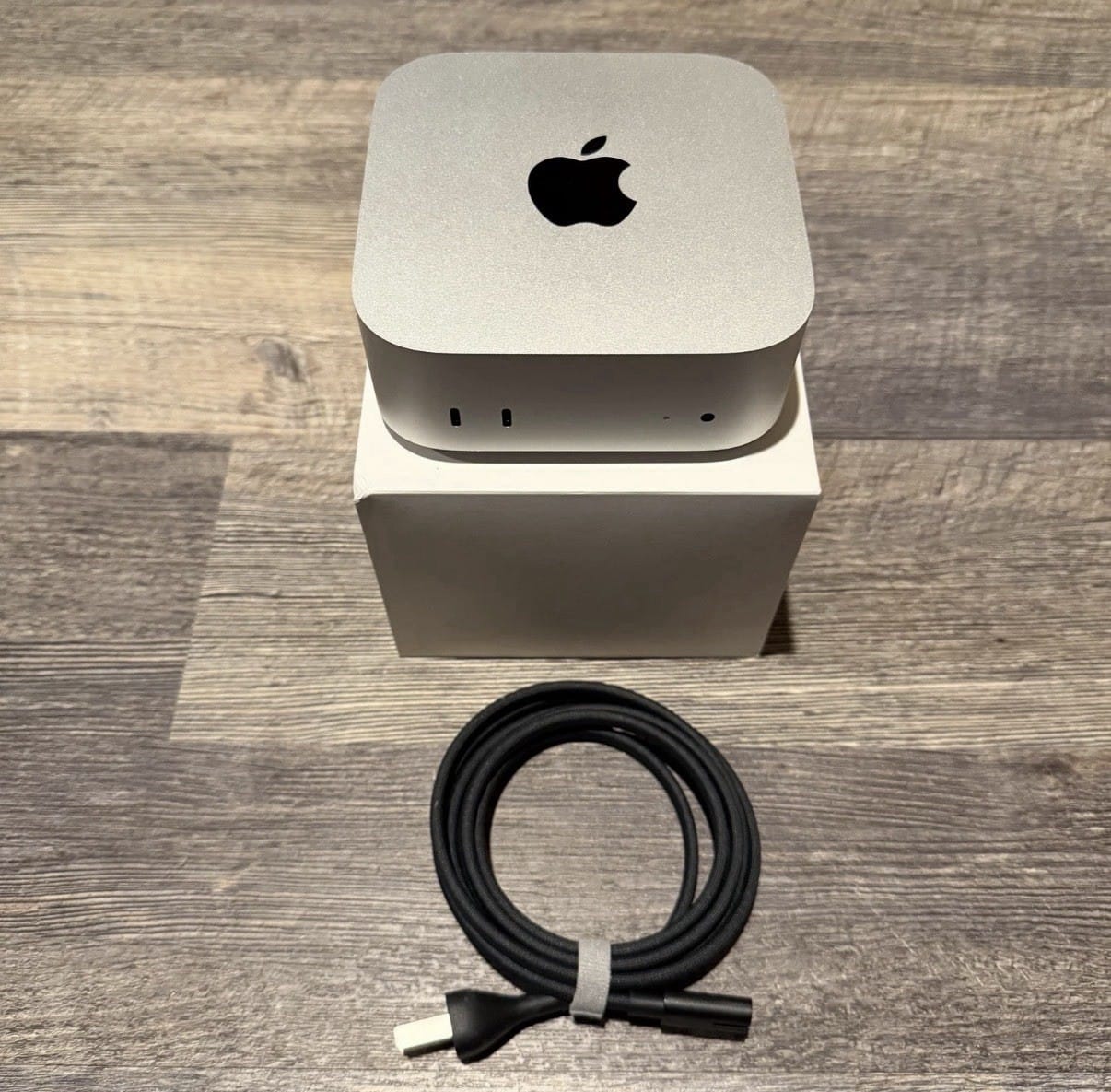
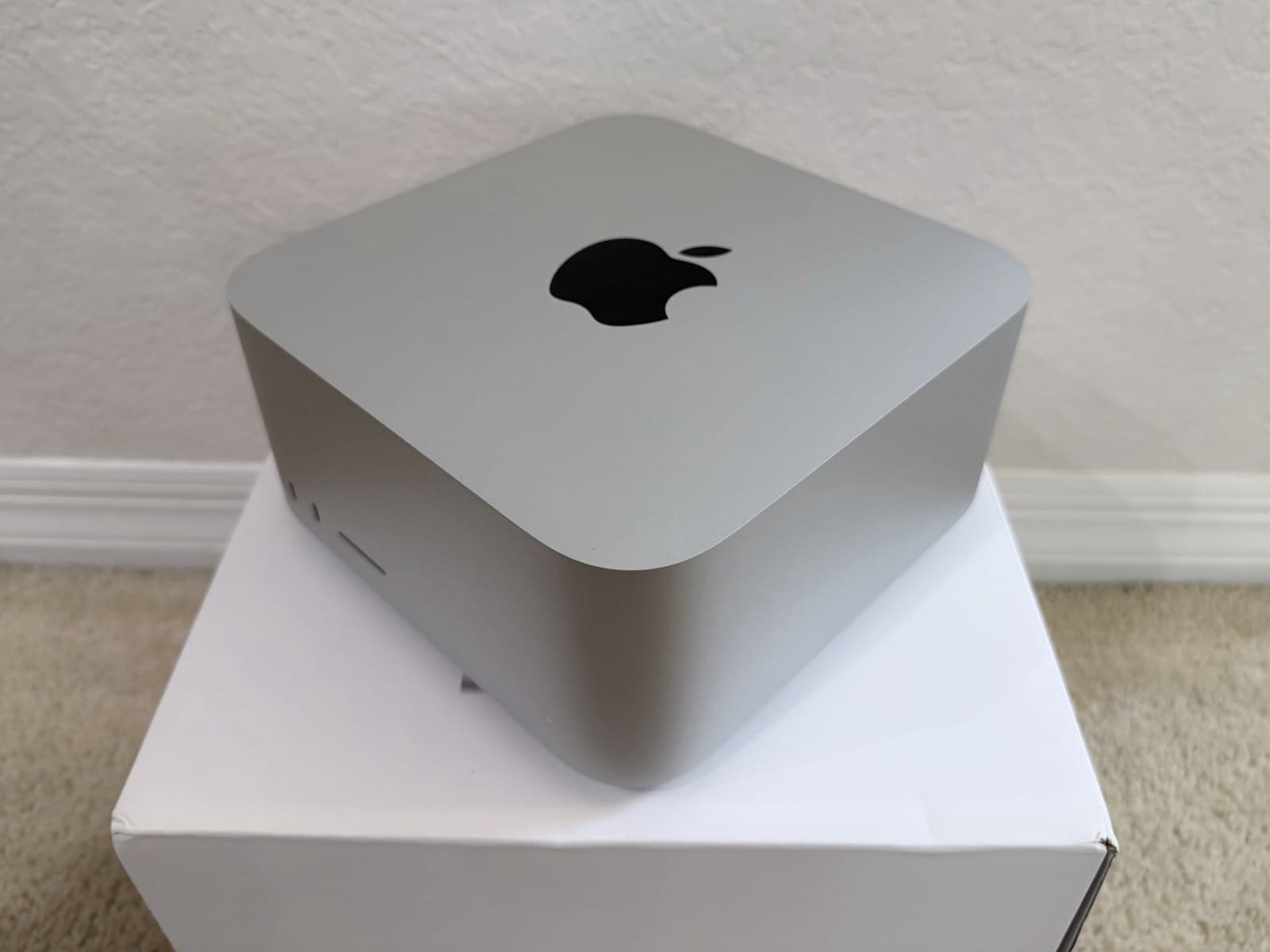
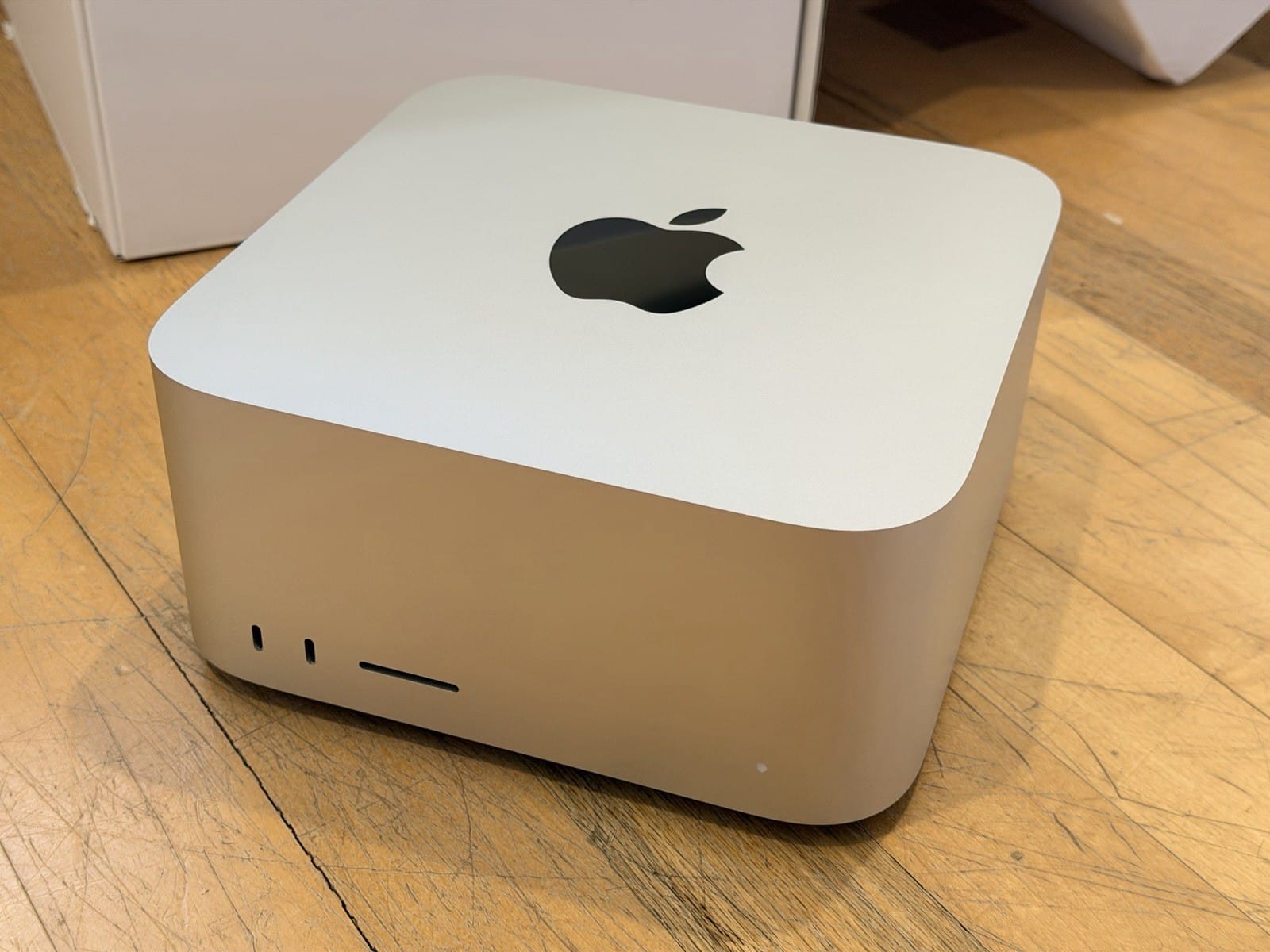
| 512GB unified | Mac Studio M3 Ultra 512GB; the M5 Ultra 512GB configuration Apple has announced for late October | Q4_K_M or MLX 4-bit, roughly 30GB spare for context | High teens tok/s generation on M3 Ultra by the bandwidth math; the M5 Ultra will be faster but nobody has measured it yet |
| 8× 96GB GPU | Eight RTX Pro 6000 (768GB), the build in this week's quad-card piece doubled | Q4_K_M with room; FP8 does not fit once the cache is counted | Fast, and a multi-user machine; well past $60,000 |
| 256GB unified | Mac Studio M5 Ultra 256GB (shipping 22 September); two DGX Sparks linked | Only the 1-bit builds, with 10 to 20GB left for cache | Unmeasured quality; on the Sparks' 273GB/s the ceiling is under 20 tok/s before the cross-box penalty |
| 128GB and below | Strix Halo boxes, DGX Spark, RTX 5090 rigs | Nothing | Use the API, or run GLM-5.3-Flash or Qwen3.8 27B instead |
Then the buy-versus-API sum, using Tencent's own prices. A million output tokens costs $2.50. A 512GB Mac Studio at $9,499 buys 3.8 billion output tokens at that rate before electricity, or about 3,800 hours of continuous generation at 18 tokens per second. If you would generate less than that over the machine's life, the API is cheaper, and it is also faster and runs the FP8 model rather than a 4-bit one. Run your own numbers in the cost calculator; the answer flips only for people who need the weights on their own hardware for privacy or offline reasons.
Verdict: worth downloading?
For almost everyone, no, and not because the model is weak. The Apache 2.0 licence, the sparse-attention design and the OpenRouter volume all say this is a serious open flagship, and the card's candour about over-thinking is more useful than most launch posts. It is simply a 512GB model. If you own a 512GB Mac Studio, the Q4_K_M or MLX 4-bit build is the most capable thing you can put on it this month, at a speed you will tolerate for agent work rather than chat. If you own anything smaller, the interesting Hy4 story is the one Tencent has promised: the "next batch of models in the Hy4 series". A Flash-sized Hy4 with this attention stack would be a different article. Until then, GLM-5.3-Flash and Qwen3.8 27B are the local picks, and Hy4 preview is an API model with a downloadable licence.
Sources and how we researched this
Creator documents: the Hy4 preview model card and Tencent's release announcement. Research: DeepSeek-V3.2 (arXiv:2512.02556) for DeepSeek Sparse Attention; IndexCache (arXiv:2603.12201). Quantization and throughput: the AngelSlim GGUF repository and mlx-community's 4-bit build. Runtime support: llama.cpp pull request 28127. Community: the Hacker News launch thread and OpenRouter traction thread, and eesel's roundup of r/LocalLLaMA reaction. Speed figures for the Mac tier are bandwidth ceilings from this site's own calculator, not measurements; we have not run the model. Non-commercial site, no retailer links.
Related: What to pre-download for a 256GB or 512GB Mac Studio · M5 Max vs M5 Ultra · What hardware runs Kimi K3 · MoE explained