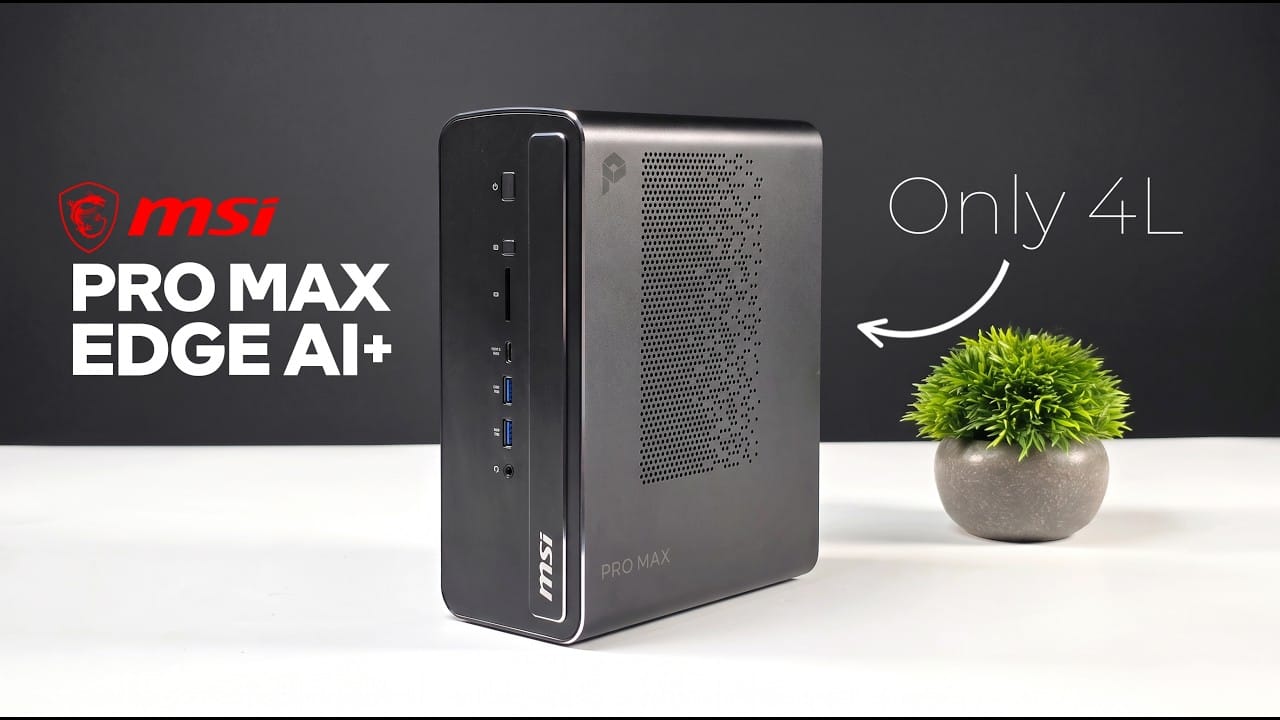
MSI has joined the Strix Halo party with a 4-litre box it calls the Pro Max Edge AI+, and ETA PRIME had one on his desk within days. In his first look (26 September 2026) it comes out as a well-built, quiet, fast little workstation with a built-in power supply and sensible power controls. It also runs the exact AMD Ryzen AI Max+ 395 with 128GB that this site has covered in boxes from Framework, GMKtec and Beelink. The difference is the price. B&H lists MSI's single configuration at $5,499. The cheapest boxes with the same chip and the same memory sell for $1,899 to $2,199 in our catalogue. So the question for a local-LLM buyer is narrow: what does the extra $3,300 buy?
What ETA PRIME found
The hardware is the full Strix Halo package: 16 Zen 5 cores and 32 threads boosting to 5.1GHz, the 40-compute-unit Radeon 8060S graphics, 128GB of LPDDR5X-8000, and up to 96GB of that assignable to the GPU from the BIOS or AMD's software. Inside are two M.2 slots for PCIe Gen 4 x4 drives, and the machine ships with Windows 11, Wi-Fi 7 and Bluetooth 5.4. It is designed to stand upright on rubber feet.
The ports are generous for the size. On the front: power button, a performance-mode button, an SD 4.0 reader, a 40Gbps USB4 port, two 10Gbps USB-A ports and a headphone jack. On the back: a second USB4 port, 2.5Gb Ethernet, another 10Gbps USB-A, DisplayPort 1.4, HDMI 2.1, two USB 2.0 ports and the power inlet. The power supply is internal (300W), so there is no external brick, a point one viewer singled out as "a nice touch".
The front-panel button is the most useful thing ETA PRIME tested, because MSI does not publish the power limits. He measured them with a CPU stress test:
| Mode | Short spike | Sustained |
|---|---|---|
| Quiet | 99W | 64–65W after about 2 minutes |
| Balanced | 120W | 100W |
| Extreme performance | 140W | 120W |
Temperatures stayed reasonable in extreme mode: 68°C while gaming at 1440p and a peak of 83°C in Cinebench. He scored 2,696 single-core and 21,640 multi-core in Geekbench, 109 and 1,891 in Cinebench R24, and 11,638 in Time Spy, a graphics score he puts on par with a mobile RTX 4060. Forza Horizon 6 ran at 65–75 FPS at native 1440p on ultra, Cyberpunk 2077 averaged about 67 FPS at 1440p ultra with FSR 4, and Crimson Desert needed frame generation to reach 88 FPS. He also ran a list of language models from 4B up to a 120B-parameter model, but those results appear only on screen and are not stated in the narration, so we do not quote them here.
What it will do for local models
Since this is the same chip on the same kind of memory, the owner measurements from other Strix Halo boxes apply. Token generation on this platform is set by memory bandwidth: a 256-bit bus of LPDDR5X-8000 gives about 256GB/s, the same on every vendor's box (the bandwidth explainer covers why). Measured numbers from owners:
| Model | Quant | Generation, tok/s | Source |
|---|---|---|---|
| Qwen3-30B-A3B (MoE) | Q4_K_M | 75–101 | visorcraft benchmarks |
| Qwen3.6 35B-A3B (MoE) | Q4_K_M, Ollama | about 60–63 | Strix Halo Guide (Beelink GTR9 Pro) |
| gpt-oss-120B (MoE) | MXFP4 | 33–57 | kyuz0 toolboxes |
| Nemotron 3 Super 120B-A12B (MoE) | IQ4_XS | 18.4 | Strix Halo Guide |
| Llama 70B (dense) | Q4_K_M | 3.7–5.1 | Level1Techs thread |
The shape is the same one we have described in the Strix Halo versus Mac piece: mixture-of-experts models with a few billion active parameters run quickly, and 70B dense models fit but crawl. MSI's own marketing claims about 15 tokens per second "on a 109B parameter model", per HotHardware's report of the launch. MSI does not name the model; a 109B MoE with around 17B active parameters would land in that range by the bandwidth arithmetic, so the claim is plausible but tells you nothing a Framework owner could not.
Two practical notes the video does not cover. First, the 96GB GPU limit is a Windows and BIOS figure. On Linux, owners raise the GPU's share of the 128GB with kernel parameters; the Strix Halo Guide documents a 128GB profile and a ROCm run that detected about 120GB of usable memory. That matters if you want a 120B-class model plus a long context. Second, the power modes should matter less for chat than for gaming. Generation is limited by memory bandwidth, which the power limit does not change, while prompt processing is compute-bound and does scale with watts (see prompt processing versus generation). So quiet mode at 65W is a reasonable default for an always-on assistant, and extreme mode earns its noise when you feed it long documents. That is our reasoning from the architecture, not something ETA PRIME measured.
MSI also advertises clustering: HotHardware reports that several units can be linked to run models up to 670B parameters, and the two USB4 ports are what make that possible. Community owners have done this with Corsair's version of the same platform over USB4. Our look at clustering three mini PCs explains why this adds capacity rather than speed, the same trade covered in layer split versus tensor parallel. At $5,499 a unit, a four-box cluster is $22,000.
The price problem
| Machine | Chip / memory | Price in our catalogue |
|---|---|---|
| MSI Pro Max Edge AI+ | Ryzen AI Max+ 395, 128GB | $5,499 (B&H listing) |
| Beelink GTR9 Pro | Ryzen AI Max+ 395, 128GB | $1,899 |
| Framework Desktop | Ryzen AI Max+ 395, 128GB | $1,999 |
| GMKtec EVO-X2 | Ryzen AI Max+ 395, 128GB | $2,199 |
| NVIDIA DGX Spark | GB10, 128GB | $3,999 |
Memory prices have risen through 2026, so every box above may cost more today than when we last checked it, but none of them costs $5,499. What MSI adds: the internal 300W supply, a 2TB drive as standard, a business-line warranty and support channel, and a front-panel power button that works. What it does not add is a single token per second. For a company buying through a reseller that needs MSI's support contract, that may be worth paying. For anyone buying with their own money to run models at home, the same silicon costs a third as much elsewhere.
What viewers are saying
Viewers liked the machine and balked at the bill. @Pirate85_Original wrote that "the Internal PSU is a nice touch", and @UnwindUnVlog called it "really cool" with "encouraging" test results. The most-liked comments were about the price: @runningman2k2 said they would not pay "almost £6000" for a design likely to be superseded within months, and @yountune9799 noted that 128GB Strix Halo boxes "were going for as low as $1700 last year". @JonHume13 made the point this piece is built on: it looks like "the same" package as Corsair's AI Workstation 300 and several other brands' versions.
Verdict
ETA PRIME's first look shows a good machine: well cooled, quiet in its low mode, fast in its high one, and tidier than most Strix Halo boxes thanks to the internal supply and front-panel mode switch. For local LLMs it will perform exactly like every other Ryzen AI Max+ 395 with 128GB, which means excellent on MoE models, slow on 70B dense, and a Linux tweak away from using more than 96GB. At $5,499 it is priced for corporate procurement, not for people who read benchmark tables. Buy the same chip for under $2,200, or check what else your budget buys in the Can I Run It tool.
Sources and how we researched this
Primary source: ETA PRIME, "MSI Pro Max Edge AI+ First Look, They Put 96GB of VRAM in a Mini PC!", 26 September 2026, summarised from the transcript with attribution; the sponsor read and description links were left out. Launch claims: HotHardware; price from B&H's listing as reported at the time of writing. Owner measurements on the same chip: visorcraft, kyuz0, the Strix Halo Guide and the Level1Techs benchmark thread. Viewer comments from the video's comment section. We have not tested this machine; the site is non-commercial and links to no retailer for money.
Related: GMKtec EVO-X3 tested by Wendell · Strix Halo vs DGX Spark