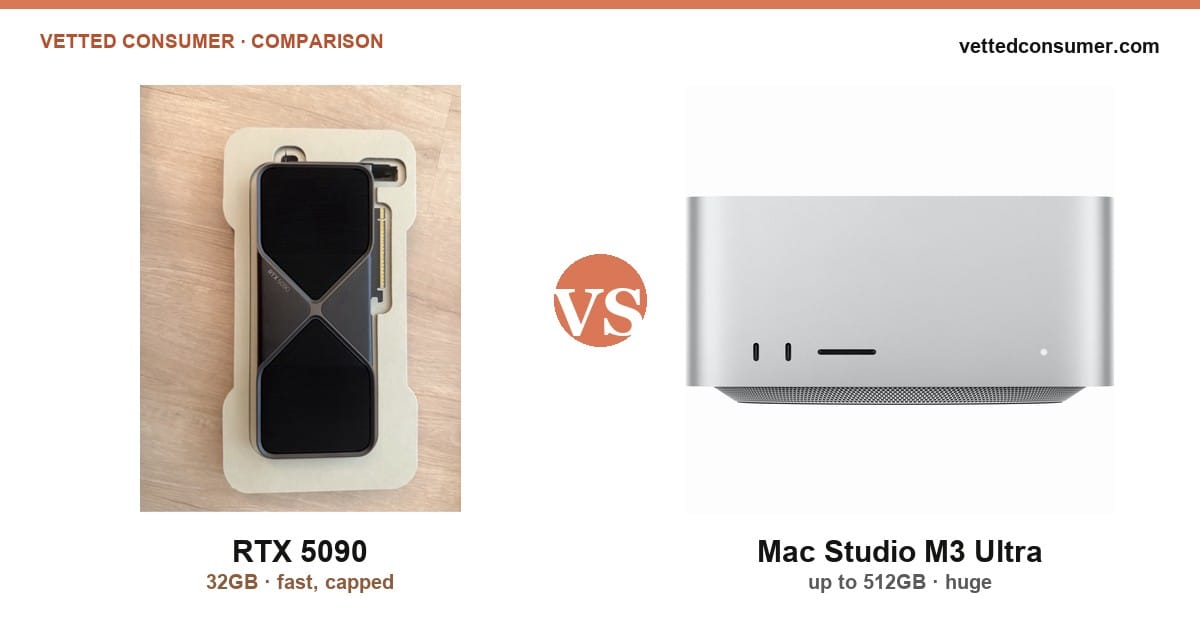
On paper this looks like a fair fight: a $2,000 graphics card against a Mac that starts at $4,000. In practice, the RTX 5090 and the Mac Studio M3 Ultra almost never run the same model. One is a bandwidth-and-compute monster with a hard 32GB ceiling; the other is a slower but enormous memory pool that holds up to 512GB. Which one wins is decided almost entirely by a single question: does the model fit in 32GB? Below that line the 5090 wins on nearly every axis. Above it, the 5090 cannot play at all.
We have not tested either machine first-hand. This synthesizes owner-measured benchmarks (LocalScore, MLX runs, and owners who ran both), the bandwidth math, and vendor specs, all linked at the end.
The two machines, side by side
| RTX 5090 | Mac Studio M3 Ultra | |
|---|---|---|
| Memory | 32GB GDDR7 (hard cap) | 96 / 256 / 512GB unified |
| Bandwidth | 1,792 GB/s | 819 GB/s |
| Compute (prefill) | Class-leading | Weak (no tensor cores) |
| Power under load | ~575W, loud | under 200W, silent |
| Software | CUDA (everything, day one) | MLX / Metal (catching up) |
| Price (mid-2026) | ~$2,700 to 3,000 street ($1,999 MSRP) | $3,999 (96GB) to ~$9,499 (512GB) |
Two prices need a footnote. The 5090's $1,999 launch MSRP is fiction in 2026; the memory shortage has pushed street prices to roughly $2,700 to $3,000, more for scalped listings. And the 512GB Mac Studio, the config that makes this comparison interesting, was pulled by Apple as a build option in early 2026 (the 512GB upgrade alone was $4,000), so a new one is effectively a used-market purchase now.
On models that fit in 32GB: the 5090 wins, but the decode gap is smaller than the spec sheet
For anything up to about a 32B dense model, both machines can load it, and here the 5090 is the better buy. But the decode-speed story is more nuanced than "twice the bandwidth, twice the speed."
| Model (4-bit) | RTX 5090 decode | M3 Ultra decode |
|---|---|---|
| Llama 3.1 8B | ~66 tok/s | ~63 tok/s |
| Qwen 32B (dense) | ~61 tok/s | ~31 tok/s |
| Qwen3 30B-A3B (MoE) | ~234 tok/s | ~95 tok/s |
Owner-measured decode (LocalScore + MLX runs). Single-config figures; treat as directional.
Look at the 8B row: on the identical LocalScore harness the two are nearly tied (66 vs 63), because an 8B model is so small that neither machine is bandwidth-starved, so the 1,792 vs 819 GB/s gap barely shows. As the model grows and starts to pressure memory bandwidth, the gap opens toward the paper 2.2x ratio: on a 32B dense model the 5090 pulls to roughly 2x. The lesson from our bandwidth explainer holds, the crossover is real but size-dependent, and on small models both are so fast it does not matter.
The 5090's real, under-reported win: prompt processing
Decode is only half the job. The other half is prefill, reading your prompt before the first word comes back, and it is compute-bound, which is exactly where the Mac's lack of tensor cores hurts. This gap is far larger than the decode gap:
| Prompt processing (4-bit) | RTX 5090 | M3 Ultra |
|---|---|---|
| Llama 3.1 8B | ~6,300 tok/s | ~1,100 tok/s |
| Qwen 32B (4K context) | ~2,900 tok/s | ~345 tok/s |
LocalScore (8B, same harness) shows ~5.7x; the gap widens on long context.
On the same small model, measured on the same tool, the 5090 processes prompts about 5.7 times faster, and on big models with long context the Mac's prefill collapses outright. Owners report a 16,000-token prompt taking around four minutes to ingest on an M3 Ultra, and a 671B model with an 8,000-token prompt taking roughly 15 minutes before the first token appears. If your work is pasting a whole codebase, RAG over long documents, or long-context agents, this is the decisive difference: you wait a few seconds on the 5090 and tens of seconds to minutes on the Mac.
Above 32GB: only the Mac can play
Here the comparison ends, because the 5090 simply cannot load these models. A 70B at 4-bit is roughly 40GB, past the 32GB wall; forcing it spills to system RAM and collapses to single digits, or demands a quality-wrecking 2-bit quant. The M3 Ultra just runs them:
| Model (4-bit) | RTX 5090 | M3 Ultra decode |
|---|---|---|
| Llama 3.3 70B (dense) | Won't fit | ~12 to 18 tok/s |
| Qwen3-235B (MoE) | Won't fit | ~24 tok/s |
| DeepSeek 671B (MoE) | Won't fit | ~18 to 20 tok/s |
| Llama 405B (dense) | Won't fit | ~3 tok/s |
Owner-measured on M3 Ultra (256 to 512GB). MoE models run far faster than their size suggests.
Big Mixture-of-Experts models are the Mac's sweet spot. DeepSeek 671B activates only ~37B parameters per token, so decode is bounded by that active slice, not the full 671B, which is why it runs at a usable ~20 tok/s while a dense 405B on the same machine crawls at ~3. That difference is the whole point of active parameters: the M3 Ultra's giant memory pool plus MoE sparsity is the combination that makes frontier-size models genuinely usable at home. The dense 405B at ~3 tok/s is the ceiling, it loads, but it is a demo, not a daily driver.
Software, power, and the rest
The 5090 runs CUDA, still the platform where everything works the day it ships: llama.cpp, vLLM, TensorRT-LLM, every quant format, and the full fine-tuning stack (Unsloth, DeepSpeed, LoRA). If you fine-tune, serve multiple users, or want the newest model immediately, this is a real advantage. Apple's MLX has closed a lot of ground in 2026 (Ollama now defaults to it on Macs, speculative decoding landed, a Metal vLLM exists) but still trails on training and bleeding-edge quant availability.
The Mac's answer is efficiency and quiet. It runs a 671B model on under 200 watts, silent, on a desk, versus the 5090's ~575W, a large power supply, and real fan noise under sustained load. For an always-on box, that gap is enormous. On raw speed per dollar for models that fit, the 5090 wins; on capability per watt for models that do not, nothing consumer touches the Mac.
What owners say
The owner reports on r/LocalLLaMA line up with the numbers. The 5090 crowd raves about speed on models that fit and grumbles about the 32GB ceiling; Mac Studio owners are stunned by what fits and clear-eyed about the compute.
On the RTX 5090. Owners running models inside 32GB are enthusiastic. One owner running Qwen3.5-35B on a 5090 wrote that it "replaced GPT-OSS-120B as my daily driver... this model is amazing." The complaint is always the ceiling. A widely-upvoted thread pleaded "we need a 80-160B model urgently," pointing out that people with "a RTX 3090/5090" are stuck choosing between small models that fit and big ones that do not.
On the Mac Studio M3 Ultra. Owners keep being surprised by raw capacity. A 512GB owner running the 671B DeepSeek R1 posted "Yes it works! First test, and I'm blown away! 18.43 tokens/sec." They are also clear about the trade: another owner summed the machine up as "a slightly weakened 3090 with 512GB," which is the whole story, the compute is modest, the memory pool is enormous.
So which should you buy?
| If you... | Buy |
|---|---|
| Run models up to ~32B, want the fastest decode and prompt processing, fine-tune, or serve users | RTX 5090 |
| Do coding, RAG, or long-context agent work (prefill matters most) | RTX 5090 |
| Need to run a 70B, a 100B+ dense model, or a big MoE (DeepSeek, Qwen 235B) at all | Mac Studio M3 Ultra (the only one that fits it) |
| Want a quiet, low-power, always-on box and can accept slow prompt processing | Mac Studio M3 Ultra |
The one-line version: the 5090 is the faster, cheaper, more capable machine right up to the 32GB wall, and useless past it. The Mac Studio is slower and pricier at any given model size, and the only consumer box that runs the models that do not fit. They are not really competitors; they are answers to different questions. To see which side of the 32GB line your model falls on, run it through our Can I run it? calculator, and price buying either against renting with the cost calculator.
Sources and how we researched this
We have not tested these machines first-hand; this synthesizes owner-measured numbers and vendor specs. Decode and prefill figures come from LocalScore (the identical-harness 8B pairing), MLX benchmark discussions, Hardware Corner's 5090 llama-bench runs, and owners of the M3 Ultra (including the DeepSeek 671B and Qwen 235B reports). Specs and pricing are from NVIDIA, TechPowerUp, Apple, and Tom's Hardware (which documented Apple pulling the 512GB option). Owner figures are single-configuration and vary by quant, context length, runtime (MLX vs llama.cpp), and driver version; several 5090 "runs a 70B" claims elsewhere are bandwidth-formula estimates, not measured runs, and a 70B does not fit 32GB at usable quant.
Related guides
- RTX 5090 review and Mac Studio M3 Ultra review, the two machines on their own
- Mac Studio M3 Ultra vs DGX Spark, the Mac against the other big-memory box
- How much VRAM you need for a 70B, why 32GB is the wall
- The used RTX 3090, the cheaper path to 48GB with two cards